

Product Content Syndication: The Complete Guide to Distributing Product Data Across Channels
 AI Summary Tools





Last updated on August 10th, 2026
Product content syndication is the process of distributing accurate, consistent product information from a single centralized source to every channel where that product is sold or discovered. It covers titles, descriptions, attributes, images, video, specifications, pricing, and compliance data, and it keeps all of that information synchronized as it changes.
Multi-channel product management gets difficult once a catalog grows past a few hundred SKUs sold through more than one storefront. A retailer, a marketplace, and a brand website rarely want the same content in the same format. Titles have different length limits, categories use different taxonomies, and images need different aspect ratios. Managing each channel by hand invites inconsistency, and inconsistency has a direct cost.
This guide walks through how syndication actually works, where content typically gets distributed, what content matters most, the systems involved, and how to adapt a single product record for very different destinations.
Table of Contents
What Is Product Content Syndication?
How Does Product Content Syndication Work?
Where Can You Syndicate Product Content?
What Product Content Should You Syndicate?
The Technology Stack Behind Product Content Syndication
How to Adapt Product Content for Different Channels
Common Product Content Syndication Challenges
What Is Product Content Syndication?
Syndication takes product data that lives in one system of record and pushes it, in the right format, to every place a customer might encounter that product. It sits downstream of product information management (PIM): the PIM holds and organizes the master data, and syndication is the mechanism that gets that data out to marketplaces, retailer portals, brand storefronts, and beyond.
It matters because product visibility increasingly happens across many touchpoints before a purchase decision gets made. Buyers commonly use six to eight touchpoints before completing a purchase, and a mismatch at any one of them, a wrong dimension, a missing certification, an outdated price, erodes the trust that gets a shopper to check out.
Improve your product content syndication capabilities with experts suggestions.
How Does Product Content Syndication Work?
Syndication runs as a repeatable pipeline rather than a single action. Product data is created and centralized, enriched with the details each channel needs, mapped to that channel’s specific requirements, transformed into the right format, validated for errors, published through the appropriate connection, monitored for failures, and refined based on how it performs. Each stage feeds the next, and skipping one is usually where listings start to break.
Step 1: Create and Centralize Product Data
A PIM system serves as the single source of truth. Instead of product details living in spreadsheets, ERP exports, and marketing folders, everything sits in one governed location that every downstream channel pulls from.
Step 2: Enrich Product Content
Raw product data gets built out with the assets a buying decision actually needs: copy, structured attributes, images, video, specifications, and compliance documentation. Thin records rarely convert well on any channel.
Step 3: Map Product Attributes to Channel Requirements
Every channel organizes products differently. A field called “voltage” internally might need to become “electrical rating” on one marketplace and a translated label on a regional portal. Mapping connects internal attributes and taxonomy to what each destination expects.
Step 4: Transform Content for Each Destination
Mapped data still needs reformatting: character limits on titles, required versus optional fields, taxonomy differences, image specifications, and regional formatting for currency, units, or language.
Step 5: Validate Product Content
Before anything publishes, content gets checked for missing fields, invalid values, formatting errors, and compliance gaps. Catching these before submission avoids rejected feeds and suppressed listings.
Step 6: Publish Through the Appropriate Connection
Depending on the channel, publishing happens through an API, SFTP transfer, XML or CSV feed, a retailer-specific template, or a direct marketplace integration. The right method depends on what that channel supports and how often the data changes.
Step 7: Monitor Synchronization
Publishing isn’t the finish line. Teams need visibility into which updates succeeded, which records failed, where data has gone stale, and where listings are missing entirely.
Step 8: Optimize Based on Performance
Closing the loop means feeding channel performance data, conversion rates, search ranking, return rates, back into content decisions so future updates improve rather than repeat the same gaps.
Where Can You Syndicate Product Content?
Syndication reaches a wide range of destinations, and each one has a different role to play. Not every channel should receive identical content: a marketplace listing optimized for search discovery looks nothing like a brand website page built for education and conversion.
|
Channel |
What It’s Typically Used For |
| Online marketplaces (Amazon, Walmart, eBay, regional marketplaces) | High-intent search and discovery, structured attributes, strict formatting rules |
| Retailer websites and portals | Listings within a retailer’s own storefront, often with retailer-specific taxonomy |
| Brand-owned ecommerce stores | Deeper storytelling, comparison content, full control over presentation |
| Google Shopping and product discovery platforms | Feed-driven visibility in search and shopping results |
| Social commerce channels | Shoppable posts and in-app checkout, shorter and more visual content |
| B2B portals and distributor networks | Technical specifications, certifications, and wholesale-specific attributes |
| Mobile apps | Condensed content optimized for smaller screens and faster load times |
| Offline and print channels | Catalogs, in-store signage, and packaging that rely on the same underlying data |
What Product Content Should You Syndicate?
Different content types carry different weight depending on where they land. The table below breaks down what typically needs to move through syndication and what to watch for on each.
|
Content Type |
Why It Matters |
Channel Considerations |
| Product title | Drives search and discovery | Length limits, taxonomy rules |
| Description | Supports conversion | Tone and depth vary by channel |
| Attributes | Powers filtering and discovery | Required fields differ by platform |
| Images | Influences conversion | Size and format specifications |
| Video | Supports education | Platform compatibility |
| Specifications | Informs decision-making | Category-dependent requirements |
| Pricing | Determines purchase accuracy | Needs frequent update cycles |
| Availability | Prevents overselling | Requires real-time or near-real-time sync |
| Compliance | Determines legal and channel eligibility | Market-specific rules |
| Localization | Affects regional relevance | Language and unit differences |
The Technology Stack Behind Product Content Syndication
Syndication depends on several systems working together rather than any single tool.
- PIM (Product Information Management): It is the central repository for product data and the source every channel pulls from.
- DAM (Digital Asset Management): It stores and organizes images, video, and other media assets.
- Feed management system: The system formats and routes data to specific channels and marketplaces.
- ERP and inventory systems: It has the supply pricing, stock levels, and availability data.
- Ecommerce and CMS platforms: They power the brand’s own storefront and content presentation.
- APIs and integration middleware: These connect systems and move data between them automatically.
- Analytics and digital shelf monitoring: they track how content performs once it’s live across channels.
These systems work together as a pipeline: the PIM and DAM hold the source data, the feed management layer and APIs move it, and analytics tools report back on what’s working so the cycle can improve.
How to Adapt Product Content for Different Channels
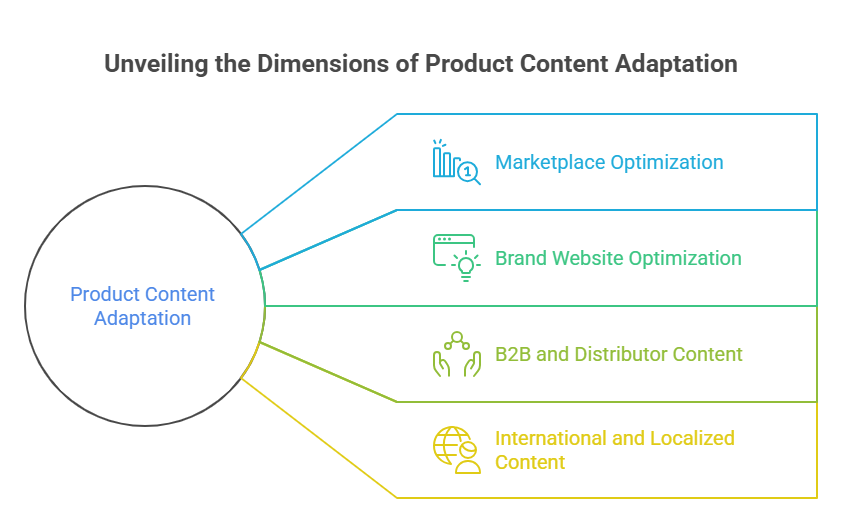
Product content needs to be adapted to the expectations, requirements, and buying behavior of each sales channel. Here’s how to tailor product information for different channels.
Marketplace Optimization
Marketplaces reward structured, search-friendly content. That means clear attribute fields, titles built around how shoppers actually search, every required field filled in, and images that meet platform-specific dimensions and background rules.
Brand Website Optimization
A brand’s own storefront can carry more depth than any marketplace allows. Longer descriptions, buying guides, comparison tables, and richer media all have room to work here, since there’s no character limit competing against them.
B2B and Distributor Content
B2B buyers evaluate differently than retail shoppers. Technical specifications, certifications, formal documentation, and wholesale-specific attributes like case pack sizes or minimum order quantities matter more than lifestyle imagery.
International and Localized Content
Selling across regions means adjusting language, units of measure, currency, and regulatory information, along with cultural considerations that affect how content should be framed for a given market.
Common Product Content Syndication Challenges
- Inconsistent source data: if the PIM record is incomplete or inaccurate, every channel inherits that problem.
- Constantly changing channel requirements: marketplaces update their schemas and specifications, which breaks feeds that aren’t monitored.
- Attribute and taxonomy mismatches: internal field names rarely match what a retailer or marketplace expects.
- Stale or delayed synchronization: price and availability changes that don’t reach every channel quickly enough lead to overselling or lost sales.
- Scaling across large catalogs: what works for a few hundred SKUs often breaks down at a few thousand without proper automation.
Product Content Syndication Example
Consider a consumer electronics brand launching a new wireless headset. Product data first gets built out in the PIM: model number, technical specifications, battery life, connectivity details, and compliance information for the markets it will sell in. The DAM stores lifestyle photography, packaging shots, and a short demonstration video.
From there, the content gets mapped and transformed for each destination. On a major marketplace, the title gets structured around search terms buyers actually use, bullet points cover key specifications, and images are cropped to the platform’s required dimensions. On the brand’s own site, the same headset gets a longer description, a comparison against other models in the line, and the full demonstration video. A distributor portal receives the technical specification sheet and certification documents instead of lifestyle imagery, since that’s what a wholesale buyer needs to evaluate the product.
Once published, the team monitors each channel for missing fields, listing suppression, or stale pricing, and adjusts based on which channels are converting best. If a specific attribute is driving strong marketplace search ranking, that insight can inform how future products get enriched from the start.
Frequently Asked Questions
1. What does product content syndication mean?
It’s the process of distributing consistent, accurate product data, including titles, descriptions, images, and specifications, from a central source to multiple sales and discovery channels.
2. What is an example of product content syndication?
A brand pushing the same core product record to Amazon, its own website, and a distributor portal, with the format and depth of content adjusted for each destination.
3. What is the difference between PIM and product content syndication?
A PIM stores and manages the master product data. Syndication is the process that distributes that data outward to the channels that need it.
4. What is the difference between a product feed and syndication?
A feed is typically a single, often static file sent to one channel. Syndication is the broader, ongoing system that manages, transforms, and monitors data across many channels at once.
5. Why is product content syndication important for ecommerce?
It keeps product information accurate and consistent everywhere a customer might encounter it, which reduces abandoned purchases and supports trust in the brand.
6. What channels support product content syndication?
Marketplaces, retailer portals, brand websites, Google Shopping, social commerce platforms, B2B portals, mobile apps, and offline or print channels can all receive syndicated content.
7. Can product content syndication be automated?
Yes. Most syndication today runs through PIM and feed management tools connected via API, SFTP, or direct integration, with minimal manual intervention once configured.
8. How does product content syndication improve SEO?
Consistent, complete, and well-structured product data improves how listings rank in both retailer search and general search engines, since incomplete or inconsistent listings tend to underperform.
9. How do you measure product content syndication?
Common measures include content completeness per channel, time-to-market for new listings, synchronization accuracy, and conversion or search ranking performance across channels.
Conclusion
Product content syndication turns a scattered, manual process into a managed system that keeps product data accurate everywhere it appears. The businesses that treat it as an ongoing operational discipline, rather than a one-time export task, are the ones that avoid the inconsistency that costs sales and erodes buyer trust across an expanding set of channels.
Getting this right at scale takes the right combination of centralized data, channel-specific formatting, and consistent monitoring. Vserve Solution supports ecommerce businesses with product catalog management and data entry services that keep listings accurate and current across the channels they sell on, so teams can focus on growth instead of manual upkeep.