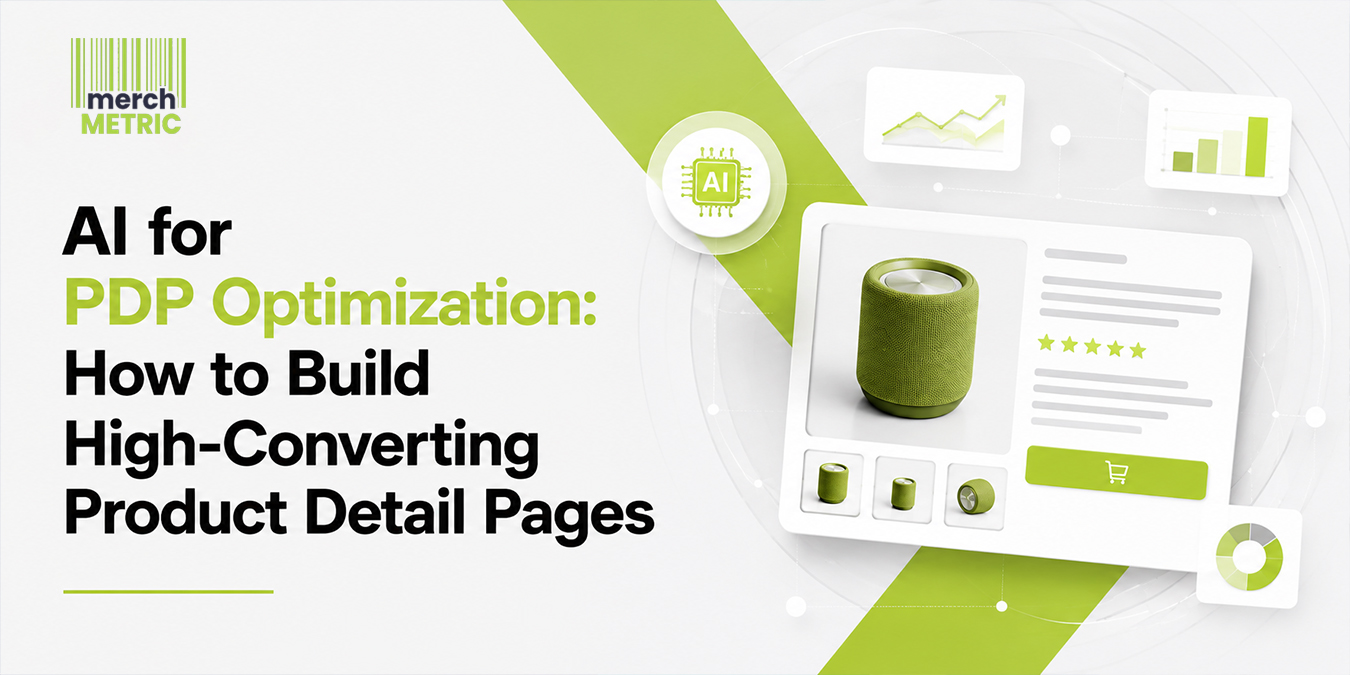
AI for PDP Optimization: How to Build High-Converting Product Detail Pages
 AI Summary Tools





Last updated on August 3rd, 2026
A product detail page (PDP) often is the point where a visitor completes a purchase or abandons the cart. As product catalogs grow, maintaining high-quality pages manually becomes quite difficult. Here, AI for PDP optimization is what helps businesses create consistent, SEO-friendly, and conversion-focused product content at scale.
Using content intelligence and advanced content optimization tools, AI can generate product descriptions, enrich attributes, optimize metadata, and personalize customer experiences. By automating repetitive tasks, businesses improve efficiency while delivering product pages that satisfy search engines and shoppers.
This guide explores how AI for PDP optimization works, its key benefits, and how businesses can use it to build scalable, high-converting product detail pages.
Table of Contents
What Is AI for PDP Optimization?
Why Traditional PDP Optimization Falls Short
How AI Optimizes Every Element of a Product Detail Page
AI Prompt Engineering for Better PDPs
AI + PIM + CMS + DAM Integration
Common AI Risks and How to Mitigate Them
What Is AI for PDP Optimization?
AI for PDP optimization refers to the use of artificial intelligence technologies to create, improve, and manage every component of a product detail page. Rather than relying entirely on manual content creation, AI analyzes product information, customer behavior, SEO requirements, and historical performance to generate optimized product experiences.
Enhance your store with AI-powered PDP optimization and product enrichment to boost conversions.
Modern AI solutions combine natural language processing, machine learning, computer vision, and predictive analytics to produce accurate and engaging product content across multiple sales channels.
Instead of treating every product page as an isolated asset, AI evaluates large volumes of product data to identify patterns and recommend improvements. This ensures consistent product content across high-volume SKU portfolios.
Why AI Is Transforming Ecommerce Product Content
Today’s ecommerce catalogs are larger and more dynamic than ever before. Businesses regularly launch new products, update specifications, adjust pricing, and expand into new marketplaces. Keeping every PDP accurate and optimized manually is both time-consuming and resource-intensive.
AI transforms this process by:
- Generating high-quality product copy within minutes
- Enriching incomplete product attributes
- Standardizing product information across catalogs
- Improving keyword placement for SEO
- Supporting multilingual product content
- Continuously updating pages based on performance insights
When combined with content intelligence, AI identifies which content elements influence customer engagement and conversions. Instead of making assumptions, businesses can optimize product pages using data-driven recommendations.
Benefits for Merchants and Brands
Implementing PDP optimization with AI offers measurable advantages across marketing, merchandising, and operations.
Some of the most significant benefits include:
- Faster product launches
- Higher content consistency
- Improved ecommerce SEO
- Better customer engagement
- Increased conversion rates
- Lower content production costs
- Scalable catalog management
- Enhanced omnichannel experiences
By integrating AI with modern content optimization tools, brands can automate repetitive work while maintaining editorial quality through human review.
Why Traditional PDP Optimization Falls Short
Many ecommerce organizations still depend on spreadsheets, manual copywriting, and disconnected workflows to manage product content. While this approach may work for smaller catalogs, it becomes increasingly inefficient as businesses expand.
Traditional PDP optimization often struggles to keep pace with changing customer expectations, marketplace requirements, and search engine algorithms.
Manual Content Bottlenecks
Creating product titles, descriptions, feature bullets, and metadata manually requires significant time and effort. Large retailers may manage tens of thousands of products, making manual updates nearly impossible.
As product catalogs grow, content teams often face:
- Publishing delays
- Limited scalability
- Increased operational costs
- Inconsistent writing quality
AI dramatically reduces production time by generating first drafts that editors can review and refine instead of writing every page from scratch.
Inconsistent Product Data
Many businesses collect product information from multiple suppliers, manufacturers, and distributors. Since each source uses different naming conventions and formatting standards, inconsistencies quickly appear across the catalog.
Examples include:
- Different units of measurement
- Missing specifications
- Duplicate attributes
- Conflicting product dimensions
- Inconsistent terminology
Using content intelligence, AI identifies these inconsistencies and standardizes product information before publication.
Slow Content Updates
Product information changes frequently. Manufacturers release new specifications, discontinue features, update compliance requirements, and introduce new variants.
Manual workflows often delay these updates, resulting in:
- Outdated product information
- Customer confusion
- Increased returns
- Reduced buyer confidence
AI continuously monitors structured product data and accelerates content updates across multiple channels.
SEO Limitations
Many manually written product pages suffer from:
- Thin content
- Duplicate descriptions
- Poor keyword placement
- Missing metadata
- Weak internal linking
Without effective content optimization tools, these issues limit organic visibility.
AI analyzes search intent and automatically recommends:
- Relevant keywords
- Optimized headings
- Meta descriptions
- Structured schema markup
- Improved readability
These enhancements strengthen search performance without sacrificing the customer experience.
Personalization Challenges
Modern shoppers expect personalized product recommendations and tailored shopping experiences.
Traditional product pages display identical content to every visitor regardless of:
- Purchase history
- Browsing behavior
- Geographic location
- Device type
- Customer preferences
AI enables dynamic personalization that adjusts recommendations, messaging, and promotional content according to individual user behavior, resulting in more relevant shopping experiences.
How AI Optimizes Every Element of a Product Detail Page
Effective AI-powered PDP optimization goes far beyond writing product descriptions. Artificial intelligence improves nearly every element that influences search visibility, customer engagement, and conversion rates.
Product Titles
Product titles affect both SEO and customer decision-making. They must describe the product and have relevant search terms.
PDP optimization with AI generates optimized titles by analyzing:
- Product category
- Brand
- Key specifications
- High-performing keywords
- Marketplace requirements
Product Descriptions
AI is adept at generating persuasive product descriptions.
AI for PDP optimization transforms technical specifications into narratives that explain:
- Benefits
- Features
- Use cases
- Value propositions
- Differentiators
AI emphasizes how the product solves customer problems while subtly incorporating SEO keywords. Businesses can also generate multiple versions for different marketplaces without duplicating content.
Feature Bullets
Shoppers often scan product pages instead of reading every paragraph.
AI creates concise, benefit-driven feature bullets that improve readability by highlighting:
- Core functionality
- Performance
- Materials
- Compatibility
- Warranty information
These bullets make complex products easier to understand and support faster purchasing decisions.
Product Attributes
Structured product attributes are essential for search filters, recommendation engines, and marketplace compliance.
AI for PDP optimization automatically enriches missing attributes such as:
- Material
- Color
- Dimensions
- Capacity
- Weight
- Compatibility
- Certifications
- Technical specifications
Metadata and Schema
Metadata influences how products appear in search engine results.
AI can automatically generate:
- SEO titles
- Meta descriptions
- Canonical tags
- Structured schema markup
- Open Graph tags
Proper schema implementation helps search engines better understand product information. It increases eligibility for rich search results, including product ratings, prices, and availability.
FAQs
Customers often have recurring questions before making a purchase.
AI analyzes:
- Customer support tickets
- Product reviews
- Search queries
- Marketplace questions
It then generates relevant FAQs that address common concerns, such as compatibility, sizing, installation, maintenance, shipping, and warranty information.
Well-written FAQs improve customer confidence while supporting long-tail SEO opportunities.
Images and Alt Text
High-quality visuals significantly influence purchasing decisions, but accessibility and SEO also matter.
AI assists by:
- Generating descriptive alt text
- Detecting image quality issues
- Recommending image sequencing
- Identifying missing visual assets
- Suggesting lifestyle imagery
Optimized image alt text improves accessibility while helping search engines understand visual content.
Video Content
Product videos consistently increase engagement and purchase confidence.
AI supports video optimization by creating:
- Video scripts
- Product highlights
- Voiceover content
- Captions
- Video summaries
It can also recommend the most effective video placement based on customer interaction data.
Customer Reviews and AI Summaries
Large volumes of reviews provide valuable purchasing insights. Many shoppers lack time to read hundreds of comments.
Using content intelligence, AI analyzes customer reviews to identify recurring themes such as:
- Product quality
- Ease of use
- Durability
- Performance
- Common complaints
- Frequently praised features
It then generates concise review summaries. They inform shoppers of the overall customer sentiment and also give access to individual reviews.
AI-Powered PDP Workflow
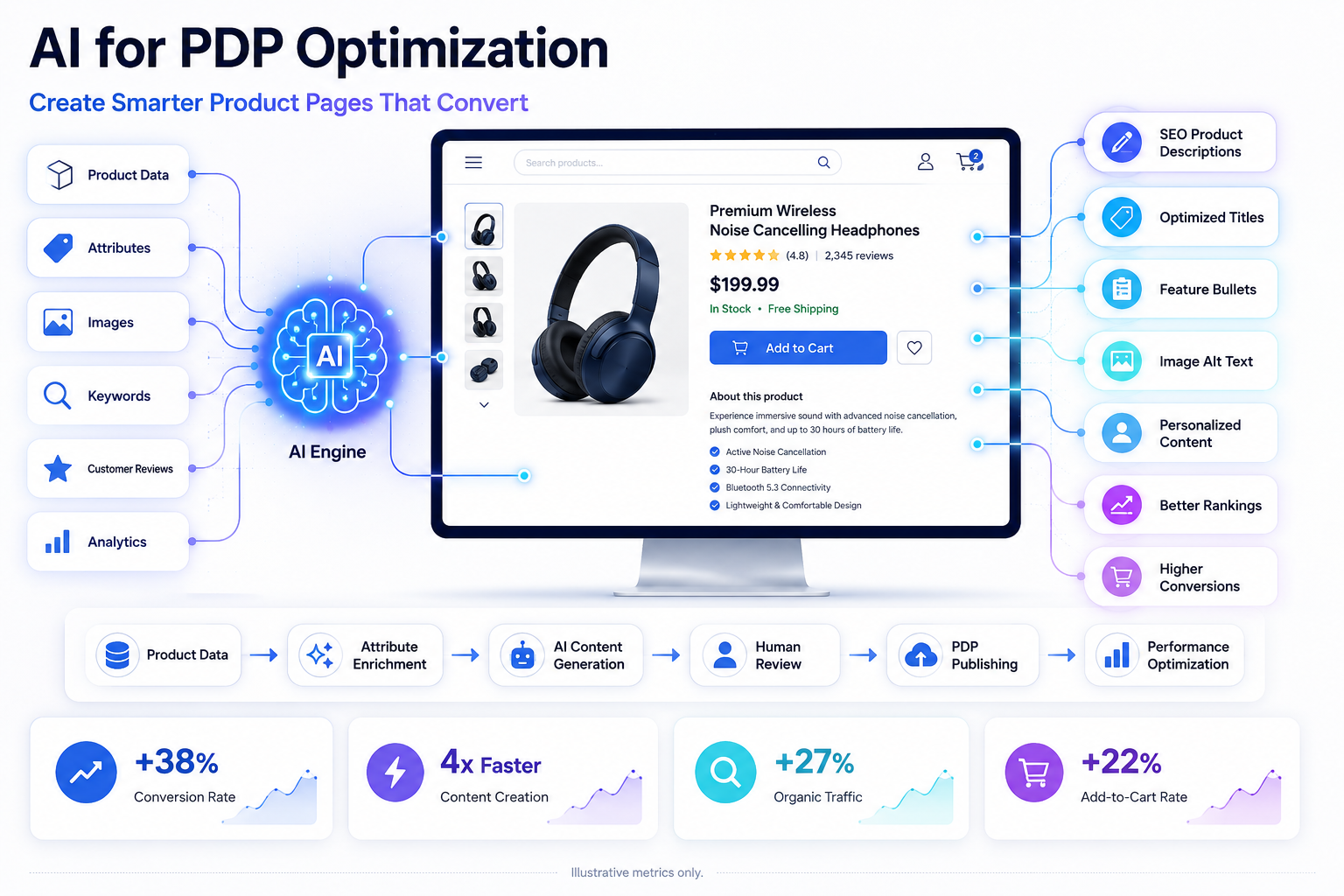
Implementing AI for product detail page optimization requires a structured workflow. This helps ensure product content remains accurate, consistent, and aligned with brand guidelines. Combining automation with human oversight, businesses can expand on their content without sacrificing quality.
- Product Data Ingestion: AI collects product data from suppliers, manufacturers, ERP, and PIM systems, standardizing information and reducing duplicates.
- Attribute Enrichment: AI fills missing specifications, standardizes attributes, and improves product categorization.
- Prompt Engineering: Well-crafted prompts define tone, keywords, audience, formatting, and compliance, enabling AI to generate consistent, SEO-friendly content.
- Content Generation: AI creates optimized product titles, descriptions, feature bullets, FAQs, metadata, and image alt text, reducing production time.
- Human Review: Editors verify accuracy, compliance, and brand voice, ensuring high-quality content.
- Publishing: Approved content is automatically published through integrated CMS and PIM systems across ecommerce sites, marketplaces, and mobile apps.
- Continuous Optimization: AI tracks search rankings, customer engagement, conversions, and user behavior to recommend ongoing improvements and strengthen PDP optimization over time.
AI Prompt Engineering for Better PDPs
Prompt engineering is important in generating high-quality AI content. Even the most advanced language models depend on clear instructions for relevant outputs.
Prompt Templates
Standardized templates create consistency across product categories. Typical prompts include:
- Product specifications
- Target audience
- Desired tone
- Formatting requirements
- Character limits
- Required keywords
Reusable templates support large-scale content generation and reduce editing time.
Brand Voice Instructions
AI prompts for the brand voice should have guidelines for writing style, terminology, sentence structure, and messaging. This will ensure all product pages sound consistent.
SEO-Focused Prompts
SEO instructions help AI to naturally incorporate primary and secondary keywords. Prompts may also request optimized headings, meta descriptions, semantic keywords, and internal linking opportunities.
Compliance Prompts
Certain industries require specific legal, safety, or regulatory language. AI prompts can instruct models to avoid unsupported claims. They include mandatory disclosures and follow marketplace content policies, reducing compliance risks.
AI + PIM + CMS + DAM Integration
The greatest value of a PDP optimization strategy with AI comes when it is integrated with existing ecommerce systems.
Data Flow Architecture
A typical workflow connects:
Supplier Data → ERP → PIM → AI Engine → CMS → Ecommerce Store → Marketplace Channels
Here, product information flows seamlessly from source systems to customer-facing platforms.
API Integrations
Modern AI solutions integrate through APIs with platforms such as Shopify, Adobe Commerce, BigCommerce, Salesforce Commerce Cloud, Akeneo, Salsify, Pimcore, and other enterprise systems. These integrations have automation for content creation, approvals, and publishing.
Automation Opportunities
Integrated AI enables businesses to automate:
- Product content creation
- Metadata generation
- Attribute mapping
- Translation
- Image tagging
- Catalog updates
- Content audits
- Performance reporting
AI Personalization for PDPs
Today, customers expect personalized shopping experiences. AI for PDP optimization delivers dynamic product pages that improve engagement and conversions.
- Dynamic Recommendations: AI analyzes browsing history and purchase behavior to recommend complementary and alternative products. This increases the average order value.
- Personalized Content: AI customizes product descriptions, promotional messages, and key benefits. They are based on customer interests and shopping behavior.
- Behavioral Targeting: Using behavioral data, AI highlights relevant offers and products. This encourages purchasing decisions.
- Regional Experiences: AI for PDP optimization adapts language, currency, measurements, shipping information, and regional promotions. This gives a boost to localized shopping experiences.
Measuring AI PDP Success
Measure AI for PDP optimization using key performance indicators.
- Conversion Rate: Measures the percentage of visitors who complete a purchase. A higher conversion rate indicates your PDP effectively persuades shoppers to buy.
- Add-to-Cart Rate: Tracks how many visitors add a product to their cart after viewing the PDP. It helps evaluate the effectiveness of your product content and page design.
- Organic Traffic: Monitors visitors arriving from search engines. Strong SEO optimization and relevant content help increase organic visibility.
- Content Production Time: Measures the time required to create and update product content. AI reduces manual effort and speeds up content delivery across large catalogs.
- Content Quality Score: Evaluates readability, consistency, SEO optimization, accuracy, and compliance. Higher-quality content improves customer trust and search performance.
- Revenue Per Visitor: Calculates the average revenue generated by each website visitor. It provides a clear measure of your overall PDP optimization success.
Common AI Risks and How to Mitigate Them
AI delivers significant benefits but requires proper governance.
- Hallucinations: Verify AI-generated technical information against trusted product data.
- Brand Inconsistency: Use standardized prompts and editorial reviews to maintain a consistent brand voice.
- Compliance Issues: Review product claims and disclosures before publishing.
- Inaccurate Specifications: Validate dimensions, materials, and compatibility using verified data.
- Human-in-the-Loop Review: Combine AI automation with human oversight to ensure quality, compliance, and continuous PDP optimization.
|
AI Capability |
Role in PDP Optimization |
Business Benefit |
| Product Description Generation | Creates SEO-friendly, engaging descriptions | Faster content creation |
| Attribute Enrichment | Fills missing specifications and standardizes data | Improved product discoverability |
| SEO Optimization | Optimizes titles, metadata, keywords, and alt text | Higher organic search rankings |
| Content Personalization | Adapts content based on customer behavior | Better engagement and conversions |
| Image & Alt Text Generation | Creates descriptive alt text and optimizes media | Improved accessibility and SEO |
| AI Recommendations | Suggests related and complementary products | Increased average order value |
| Quality & Compliance Checks | Detects content errors and policy violations | Greater accuracy and consistency |
| Performance Analytics | Analyzes PDP metrics and recommends improvements | Continuous optimization and higher ROI |
Future Trends in AI for PDP Optimization
AI-driven PDP optimization will continue transforming ecommerce content and customer experiences.
Agentic AI
Agentic AI will autonomously monitor product performance, identify content gaps, generate optimized product content, and manage publishing workflows. By reducing manual intervention, it enables ecommerce teams to maintain accurate, high-performing product detail pages at scale while continuously improving conversions, efficiency, customer engagement, and overall operational productivity.
Generative Search Optimization
As AI-powered search becomes more prevalent, businesses will optimize PDPs with structured, trustworthy, and comprehensive content to improve visibility in generative search results. This strategy for PDP optimization helps brands increase discoverability, drive qualified traffic, strengthen search authority, enhance customer trust, and stay competitive in evolving digital search experiences.
Conclusion
AI PDP optimization solutions help ecommerce businesses create, manage, and improve product detail pages in high volumes. Combined with content intelligence and content optimization tools, AI produces high-quality product content faster, improves search visibility, and delivers personalized shopping experiences.
The best results come from combining AI with accurate product data, effective prompt engineering, human oversight, and integrated PIM, CMS, and digital asset management systems. Together, these capabilities enable scalable, high-converting PDPs that drive long-term ecommerce growth.
Frequently Asked Questions
1. Can AI write product descriptions?
Yes. AI creates SEO-friendly product descriptions from structured product data, though human review ensures accuracy and brand consistency.
2. Will AI improve ecommerce SEO?
Yes. AI optimizes titles, descriptions, metadata, structured data, and keyword placement while improving search relevance.
3. How accurate is AI-generated product content?
Accuracy depends on product data quality and prompt engineering. Human validation is recommended before publishing.
4. Can AI optimize existing PDPs?
Yes. AI audits existing PDPs, identifies content gaps, enriches attributes, improves SEO, and enhances conversions.
5. How do you maintain brand voice with AI?
Use standardized prompts, style guides, approved terminology, and editorial reviews.
6. What data is needed for AI-generated PDPs?
Comprehensive product information, including specifications, attributes, images, pricing, categories, and customer reviews.