
AI in Product Content Management: The Complete Guide for 2026
 AI Summary Tools





Last updated on July 27th, 2026
Product content plays a key role in helping customers find, understand, and buy products across ecommerce websites, online marketplaces, social commerce platforms, and search engines. As product catalogs grow, managing accurate and consistent information becomes more difficult. This is why more businesses are adopting AI in product content management to simplify content creation and improve efficiency.
When using AI in product content management, businesses can automatically generate product descriptions, complete missing attributes, and organize products into the right categories. They can optimize listings for search engines and localize content for different markets. This reduces manual work while improving content quality and consistency.
The use of AI in product content management helps businesses create accurate, engaging, and channel-ready product content for small to very large SKU volumes. It gets done faster, improving search visibility, customer experience, and overall ecommerce performance.
Table of Contents
Why Traditional Product Content Management Falls Short
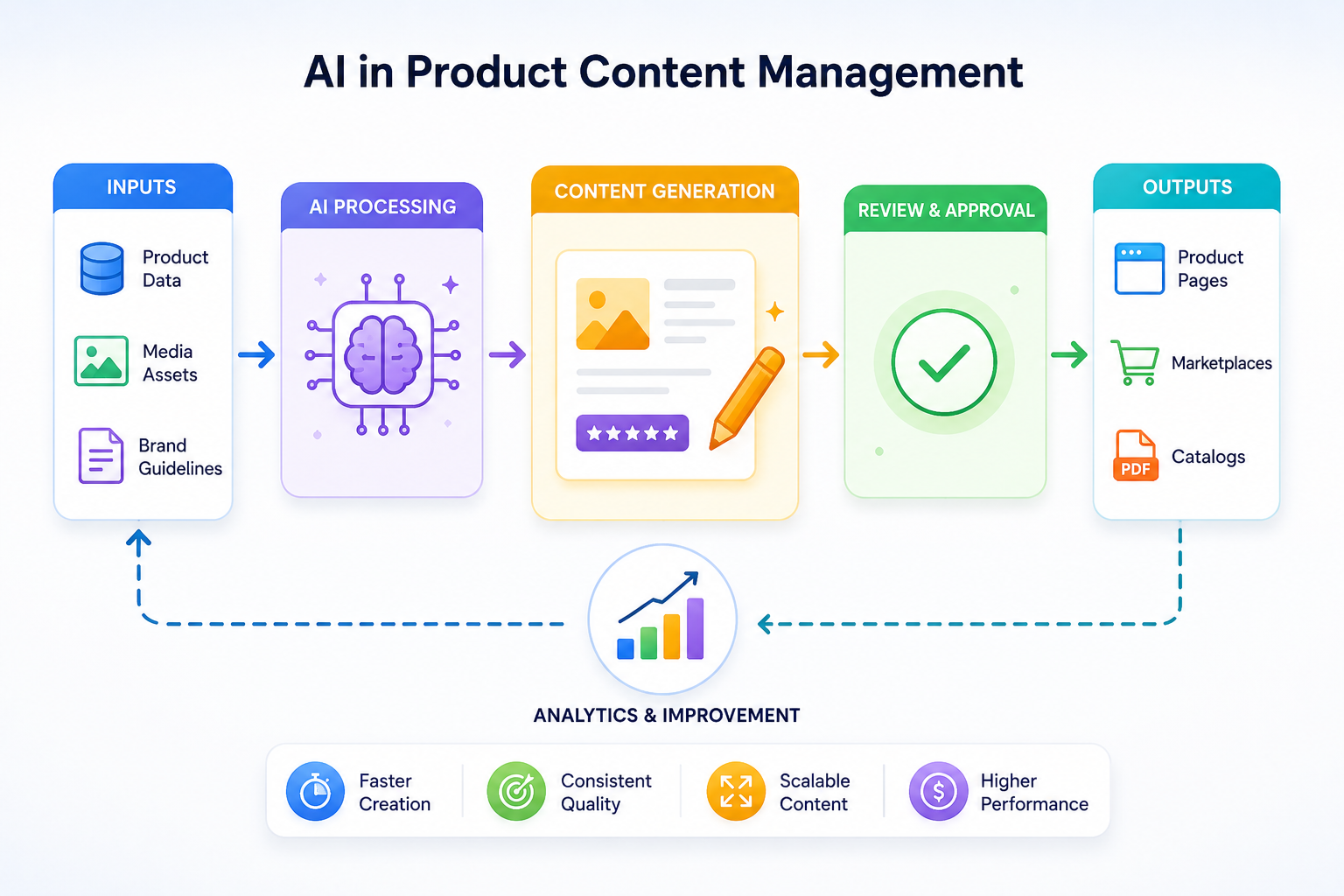
How AI Transforms Product Content Management
AI Across the Product Content Lifecycle
Core AI Technologies Behind Product Content Management
Traditional vs AI for Product Content Management: A Quick Comparison
Benefits of Using AI in Product Content Management
Best Practices for Successful Implementation of AI in Product Content Management
Why Traditional Product Content Management Falls Short
Although product information is the foundation of digital commerce, many organizations still rely on manual workflows. This creates bottlenecks throughout the product lifecycle. In today’s age, catalogs are expanding and selling channels are multiplying. Here, these traditional approaches are becoming increasingly difficult to maintain.
Implement intelligent workflows to expand catalogs and deliver better customer experiences.
Manual Content Creation
Creating product titles, descriptions, specifications, and marketing copy manually requires significant time and effort. Content teams often spend hours researching product features and rewriting similar descriptions. They also have to ensure formatting consistency. When thousands of new products need to be published, manual writing slows operations. It delays product availability.
Even experienced teams may produce varying writing styles, terminology, and levels of detail. This makes it difficult to maintain a consistent brand voice across an entire catalog.
Inconsistent Product Data
Product information originates from multiple suppliers, manufacturers, distributors, and internal systems. Each source follows different formatting standards. They have different naming conventions, measurement units, and attribute structures. Without standardized validation, catalogs quickly become inconsistent.
Missing dimensions, incomplete specifications, duplicate records, incorrect attributes, and conflicting product information form the basis for increasing support requests and return rates.
Slow Product Launches
Launching new products involves collecting supplier data, validating information, writing descriptions, enriching attributes, reviewing content, obtaining approvals, and publishing across multiple channels. These manual processes often stretch from days into weeks.
Delayed product launches mean businesses miss seasonal demand, promotional opportunities, and competitive advantages.
Scaling Challenges
Managing hundreds of products manually may not be a complex task. But when it runs into tens of thousands, there is significant operational complexity. Every new product requires writing, editing, categorization, SEO optimization, image management, and quality assurance.
As catalogs grow, businesses frequently hire additional content teams simply to maintain existing workflows. This increases operational costs without necessarily improving quality or efficiency.
Localization Complexity
Global ecommerce content management demands localized product content that reflects regional languages. They want the cultural preferences, measurement units, regulatory requirements, and marketplace standards to be built into it.
Traditional translation workflows rely heavily on external agencies. This makes localization expensive and time-consuming. Besides, they have to update translated content across multiple regions whenever product information changes. This is another very challenging aspect.
How AI Transforms Product Content Management
AI acts as an intelligent assistant that automates repetitive tasks. This enables experts to focus on strategic decision-making, brand storytelling, and quality assurance.
Today, there is a combination of language models, machine learning, natural language processing, and computer vision to manage product content. The use of AI in product content management helps generate richer product experiences with greater speed and consistency. AI continuously improves and optimizes product content throughout its lifecycle.
Content Generation
AI can generate high-quality product titles, descriptions, bullet points, feature lists, buying guides, and promotional copy using structured product data. It adapts content for different product categories while maintaining a consistent tone and brand voice. Content teams now spend time refining messaging as per consumer behavior for high-value products and campaigns.
Attribute Enrichment
Many supplier catalogs contain incomplete or inconsistent product information. AI automatically identifies missing attributes and recommends values. They use information from product specifications, historical data, manufacturer documentation, and similar products This improves filtering, navigation, customer confidence, and marketplace compliance.
Product Categorization
Accurate categorization is essential for ecommerce navigation, internal search, and marketplace visibility. AI analyzes product names, descriptions, specifications, and images to classify products into the appropriate categories and subcategories. This AI-led categorization improves catalog organization and discoverability.
SEO Optimization
Search visibility depends heavily on optimized product content. AI identifies relevant keywords, improves product titles, enhances descriptions, and structures metadata. It recommends content updates based on evolving search behavior. This helps products rank higher in both search engines and marketplace search results. Click-through rates and conversions naturally improve.
Translation and Localization
AI significantly accelerates multilingual content creation by translating product information into multiple languages. This aspect of product page management helps preserve product context and technical accuracy. Localization capabilities also adapt measurements, terminology, currencies, and regional expressions. The aim is to match local customer expectations. Businesses can enter new international markets faster without sacrificing content quality.
Image Tagging and Metadata Generation
Product images contain valuable information that often remains unused. Computer vision algorithms automatically recognize colors, materials, patterns, styles, product types, and visual features. AI then generates image tags, alt text, searchable metadata, and accessibility descriptions, improving search visibility and customer experience.
Content Quality Validation
AI continuously reviews product content for grammar, spelling, formatting consistency, duplicate information, missing attributes, compliance issues, and brand guideline violations. Businesses can now identify and resolve content issues before products reach customers. This reduces costly corrections.
AI Across the Product Content Lifecycle
For the best results, AI in product content management should be used at every stage of the product content lifecycle. It helps automate tasks, improve accuracy, and speed up decision-making.
Data Ingestion
Product information often comes from different sources with different formats, duplicate records, missing specifications, and incorrect attribute values. AI automatically collects product information, organizes it into a standard format, and finds duplicate entries. It checks data quality and matches supplier information with internal catalog structures. This creates a clean and reliable base for the next steps in product content creation.
Product Enrichment
Once raw product data is imported, AI enriches it by adding more useful information. It creates detailed product descriptions, fills in missing specifications, and recommends related accessories. It also identifies product features, standardizes attribute values, and improves metadata. AI can even predict missing details by comparing similar products or studying manufacturer documents.
The result is richer, more complete product listings that improve searchability and help customers make better buying decisions.
Review and Approvals
AI automates many parts of the content creation process. However, human expertise is still important for maintaining accuracy, compliance, and brand consistency.
AI-powered workflows automatically identify missing information, detect inconsistencies, and flag possible compliance issues. They also highlight products that need manual review. This allows content managers to focus only on products that need attention. This reduces approval time while maintaining high content quality.
Publishing
After approval, product content must be published consistently. It should feel the same across ecommerce websites, online marketplaces, mobile applications, print catalogs, social commerce platforms, and retail partner portals.
AI works well at preparing channel-specific content. It adjusts titles, descriptions, attributes, image metadata, and formatting so that it matches each platform’s requirements. This helps keep product information accurate, consistent, and optimized wherever and whenever the customers see it.
Syndication
Most businesses publish product information across multiple sales channels. The same product may appear on Amazon, Shopify stores, retail partner websites, Google Shopping, social commerce channels, and distributor networks.
AI keeps product information consistent while adjusting platform requirements, taxonomies, and attribute mapping for each channel. This lowers the risk of inconsistent product listings across sales channels.
Performance Optimization
Product content should continue improving even after it is published. AI tracks customer engagement, search rankings, click-through rates, conversion rates, bounce rates, and product reviews. It finds areas that need improvement.
Using these insights, AI recommends updates to product titles, descriptions, keywords, images, and attributes. This supports continuous product content optimization. It helps businesses improve search visibility and sales performance over time.
Core AI Technologies Behind Product Content Management
Artificial intelligence is a group of advanced technologies that work together to automate, improve, and expand product content. Each group has a different role in helping businesses create richer, more accurate, and customer-friendly product experiences.
Large Language Models (LLMs)
Large Language Models (LLMs) are trained using huge amounts of text to understand language, meaning, and user intent. In product content management, they create product titles, descriptions, feature lists, FAQs, buying guides, and marketing copy. They do this while keeping a consistent brand voice. LLMs also help rewrite content, shorten long text, and keep content consistent across large product catalogs.
Generative AI
Generative AI creates new content instead of only studying existing information. It can write engaging product descriptions, SEO-friendly copy, promotional content, and category pages. AI also gives personalized messages. This helps businesses launch products much faster.
Machine Learning
Machine learning allows systems to learn and improve from past product data. It finds patterns, predicts missing attributes, and suggests product categories. It also detects duplicate listings, and improves data accuracy based on earlier updates. As more and more product data becomes available, machine learning models continue improving their suggestions automatically.
Computer Vision
Computer vision studies product images to identify objects, colors, materials, styles, sizes, packaging, and other visual details. It automatically creates image tags, accessibility descriptions, metadata, and searchable attributes. It also helps detect poor-quality images and duplicate assets across product catalogs.
Natural Language Processing (NLP)
Natural Language Processing helps AI understand written language. It helps it to find useful information and recognize connections between words and phrases. NLP improves attribute extraction, keyword identification, and sentiment analysis. It also helps improve product classification, search optimization, and multilingual content management.
AI Agents
AI agents are the next step in automation. Instead of handling only one task at a time, they manage complete workflows. They collect supplier information, enrich product attributes, generate customer-focused content, and check quality. They also send products for approval and publish listings across multiple channels with very little human involvement.
Traditional vs AI for Product Content Management: A Quick Comparison
The table below shows the key differences between traditional and AI-powered product content management. Discover how AI helps businesses improve efficiency, accuracy, and overall content quality.
|
Feature |
Traditional Product Content Management |
AI for Product Content Management |
| Content Creation | Manual writing by content teams | AI generates product content in seconds |
| Product Enrichment | Time-consuming manual updates | AI fills missing attributes automatically |
| SEO Optimization | Manual keyword research and updates | AI optimizes titles, descriptions, and metadata |
| Product Categorization | Manual classification | AI recommends accurate product categories |
| Data Quality | Errors and inconsistencies are common | AI detects missing data, duplicates, and errors |
| Content Consistency | Varies between teams and channels | Maintains a consistent brand voice across channels |
| Translation & Localization | Requires manual translation | AI translates and localizes content quickly |
| Publishing | Manual publishing for each channel | AI prepares channel-ready content automatically |
| Catalog Scalability | Difficult for large product catalogs | Easily manages thousands of SKUs |
| Time-to-Market | Slower product launches | Faster content creation and publishing |
| Operational Costs | Higher due to manual work | Lower through intelligent automation |
| Customer Experience | Can vary depending on content quality | Rich, accurate, and engaging product content |
Benefits of Using AI in Product Content Management
Organizations adopting AI in product content management gain measurable improvements. They improve in efficiency, accuracy, and customer experience. AI amplifies the work done by humans by automating repetitive work and supporting better decision-making.
- Faster Time-to-Market: AI dramatically reduces the time required to create, enrich, review, and publish product content. Businesses can launch and respond to changing market demands faster.
- Improved Consistency: AI standardizes titles, descriptions, specifications, attributes, and formatting across every product and sales channel. This strengthens brand identity and reduces customer confusion.
- Better SEO: AI continuously improves keywords, metadata, product descriptions, image alt text, and search relevance. This increases organic visibility and drives more qualified traffic.
- Reduced Operational Costs: Automating repetitive content tasks lowers manual effort. You need smaller teams, and you minimize costly corrections caused by inconsistent or incomplete product information.
- Higher Content Quality: AI detects spelling mistakes, missing specifications, and duplicate information. It also detects formatting inconsistencies and compliance issues before publication.
- Improved Customer Experience: Rich, complete, and accurate product information helps customers compare products. Better content often leads to higher conversion rates and fewer product returns.
Risks and Challenges
Successful implementation of AI requires thoughtful planning, governance, and ongoing human oversight. Organizations should recognize the following challenges before deploying AI.
- Hallucinations: AI can occasionally generate inaccurate or fabricated information. This is because of insufficient product data. Every AI-generated output should be validated before publication.
- Governance: With no clearly defined policies in place, AI-generated content may vary across teams and channels. Approval workflows and governance standards are needed for content to remain accurate and accountable.
- Compliance: Many industries require strict adherence to legal, regulatory, and marketplace guidelines. Always review to verify technical claims, safety information, and compliance requirements.
- Brand Consistency: Content could differ from established brand guidelines if prompts and templates are not standardized. Organizations should define style guides and approved messaging frameworks.
- Human Oversight: AI works best when combined with experienced content managers. These managers validate information and refine messaging using their subject-matter expertise.
- Data Privacy: Businesses use sensitive supplier information, proprietary product data, and customer-related information. This must remain secure when using AI platforms. Proper access controls and data governance policies are essential.
Best Practices for Successful Implementation of AI in Product Content Management
For using AI successfully, businesses should first create a single source of truth. This is where all product information is stored, kept accurate, and updated regularly. They should connect AI with Product Information Management (PIM), Digital Asset Management (DAM), and Content Management Systems (CMS). This helps every team use the same reliable product data and reduce errors.
Human review is very important when you use AI. Businesses should create clear prompts, brand guidelines, approval steps, and review processes. They should make sure the AI-generated content is accurate and matches their brand. They can do this by tracking KPIs such as content completeness, publishing speed, SEO performance, conversion rates, and data accuracy. These metrics help businesses measure results, improve over time, and get the most value from their AI investment.
Conclusion
As ecommerce catalogs continue to expand, traditional product content management can no longer keep up with the speed and volumes that businesses demand. The use of AI product content management solutions helps automate repetitive tasks, enrich product information, and improve search visibility greatly. It picks up the speed of product launches and supports high-quality product content across every sales channel.
To get the best results, businesses should use AI in product content management along with strong data governance and centralized product information. There should be clear workflows and human supervision. This helps teams create accurate, consistent, and channel-ready product content that maintains brand quality. As AI continues to evolve, businesses that adopt it quickly will be better prepared to manage larger catalogs and meet changing customer expectations.
Frequently Asked Questions
1. What is AI Product Content Management?
AI in product content management helps automate the creation, improvement, optimization, checking, and publishing of product information across digital sales channels. It helps businesses create accurate, consistent, and customer-friendly product content and saves time.
2. How is it different from PIM?
A Product Information Management (PIM) system stores and manages product data in one central place. AI improves that data by creating product descriptions, filling in missing attributes, and improving SEO. It checks content quality and suggests updates. Together, AI and PIM make product content management faster and increase performance.
3. Can AI replace product content managers?
No. AI can handle repetitive tasks, but product content managers are still needed for supervision. They have to maintain brand voice, check accuracy, meet compliance requirements, and make important content decisions. The best results come from combining AI with human expertise.
4. Which AI tools work best with PIM?
Many AI tools work well with leading PIM, CMS, and DAM platforms. Businesses often use Large Language Models (LLMs), machine learning, Natural Language Processing (NLP), and computer vision to improve content quality.
5. How does AI improve SEO for product content?
AI improves SEO by creating optimized product titles, descriptions, metadata, image alt text, and relevant keywords. It also studies search trends and customer behavior to support continuous product page optimization. This helps products rank higher in search engines and online marketplaces.
6. What are the biggest implementation challenges?
Some common challenges include keeping product data accurate and preventing AI from creating incorrect information. Besides, maintaining governance, protecting sensitive data, and keeping a consistent brand voice are also important. It is necessary to have human teams review AI-generated content before it is published.