

Why Product Content Management Is Essential for Consistent Brand Messaging Across Platforms
 AI Summary Tools





Last updated on May 26th, 2026
The modern eCommerce world feels enormous. Products appear everywhere at once. You find them on Amazon, Walmart, Shopify stores, Instagram Shops, Google Shopping, and even AI-powered search assistants. A customer may discover your product on one platform, compare it on another, and purchase it somewhere entirely different five hours later while sitting in traffic. That is the buying journey has changed the rules.
Today, brands are not only competing on price or product quality. They are competing on clarity, consistency, speed, and relevance. A product listing that feels incomplete or confusing quietly pushes customers away. Meanwhile, intelligent and clear product content creates confidence and trust in the customer.
This is where a strong product content management platform becomes essential.
Businesses are now using AI powered product content management platform technologies to organize product data, optimize listings, personalize experiences, and maintain consistent messaging across every digital shelf. The result is clean and lean content that is constantly adapting and improving visibility, engagement, and conversions simultaneously.
Some brands still treat product pages like storage rooms for specifications. Smart brands treat them like digital salespeople.
Table of Contents
Understanding Product Content Management
What Is Product Title Optimization, and Why Is It Important for E-commerce?
How Can I Improve Product Page Optimization to Boost My Sales?
What Are the Best Practices for Effective Product Content Management Software?
How Does Product Content Optimization Impact SEO and Conversion Rates?
What Are the Top Strategies for Increasing Product Page Conversion Rate?
How Can I Use Keywords Effectively in Product Title Optimization?
What Tools Are Available to Optimize Product Pages on Amazon?
How Can AI Product Content Management Solutions Improve Customer Engagement?
What Elements Are Essential for Effective Product Page Optimization?
How Does Product Content Optimization Differ From Product Information Management (PIM)?

Understanding Product Content Management
Product content management, often shortened to PCM, is the process of creating, organizing, optimizing, and distributing product information across multiple channels. It includes product titles, descriptions, specifications, images, videos, keywords, reviews, and brand messaging.
A good product content management software system ensures that all product information stays accurate and consistent everywhere. That consistency matters more than many businesses realize. If a product description says one thing on Amazon and another thing on a brand website, customers become uncertain. Uncertainty slows down purchases.
Modern product content management solutions also use AI to analyze customer behavior, identify search trends, recommend keywords, and improve listing performance automatically. In 2026, PCM is important enough to be a part of the revenue strategy.
What Is Product Title Optimization, and Why Is It Important for eCommerce?
Product title optimization is the process of creating titles that work for both humans and algorithms.
A weak title disappears into search results. A strong title attracts the spotlight.
An optimized title should:
- Include primary keywords naturally
- Mention important product features
- Remain readable and clean
- Match customer search intent
- Avoid keyword stuffing
For example:“Wireless Bluetooth Earbuds with Noise Cancellation and Long Battery Life” works far better than simply: “Bluetooth Earbuds”
The first title speaks the customer’s language. It answers hidden questions before they are even asked.
AI powered product content management platform systems now help brands generate intelligent title variations based on live search behavior. This allows businesses to adapt faster to changing customer interests without manually rewriting thousands of listings.
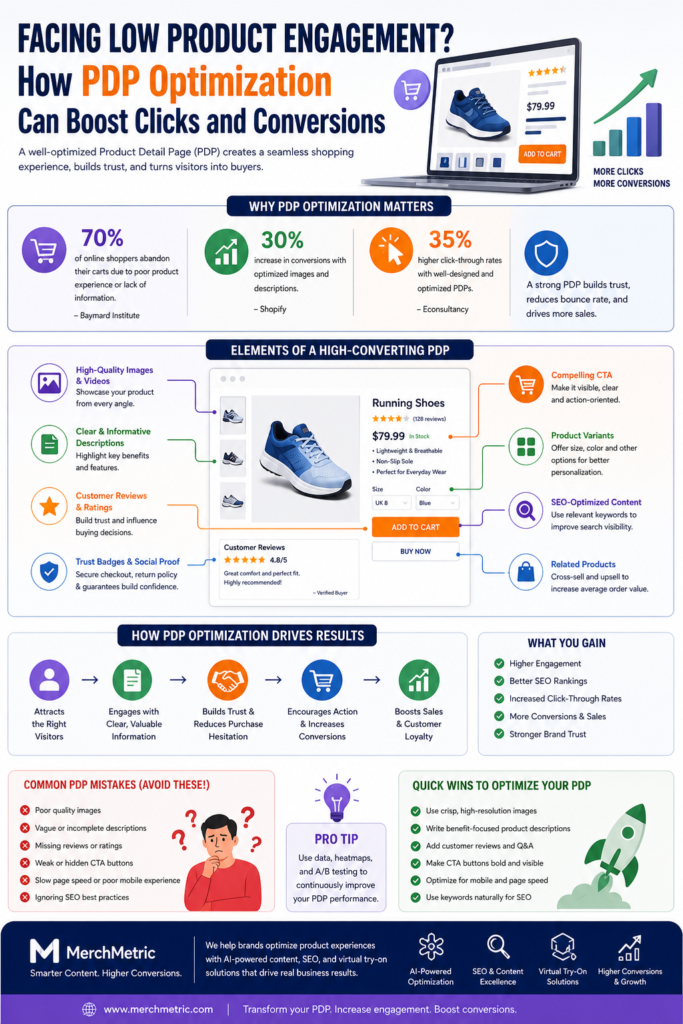
How Can I Improve Product Page Optimization to Boost My Sales?
A product page should not feel mechanical. Many brands overload pages with specifications while forgetting emotional clarity. Customers do not buy features alone. They buy confidence.
To improve product page optimization:
Use High-Quality Images
Clear product visuals increase trust dramatically. Multiple-angle photos, zoom features, and lifestyle images help customers understand the product better.
Virtual try-on technologies are also becoming increasingly important. They have an important role to play, especially in fashion, eyewear, beauty, and accessories. These tools reduce hesitation and create interactive shopping experiences.
Write Human Product Descriptions
Descriptions should sound natural. Explain how the product improves daily life instead of collecting technical jargon.
Good descriptions quietly answer:
- Why should I trust this?
- How does this help me?
- Is this worth the money?
Add Reviews and Social Proof
Customers trust other customers. Reviews reduce uncertainty and improve conversion rates significantly.
Improve Mobile Experience
More than half of eCommerce traffic now comes from mobile devices. Slow-loading pages or badly formatted content quietly destroy sales.
Modern product content management services often include mobile optimization as part of their strategy. Nearly 6 out of 10 consumers say a mobile-friendly shopping experience directly influences their purchasing decisions, highlighting the importance of optimized PDPs for mobile users.

What Are the Best Practices for Effective Product Content Management Software?
Strong PCM strategies are built on structure, consistency, and adaptability.
Some best practices include:
Centralize Product Data
Using a product content management platform allows brands to manage product information from one centralized system.
This prevents inconsistent listings across platforms.
Keep Content Updated
Search behavior changes constantly. Trends shift, and features evolve. Seasonal keywords appear, disappear, and appear again.
Regular updates keep listings relevant.
Use AI for Smarter Optimization
AI product content management solutions can:
- Suggest better keywords
- Detect missing product data
- Improve SEO structure
- Generate optimized descriptions
- Personalize recommendations
Analyze Performance Metrics
Track:
- Click-through rates
- Conversion rates
- Bounce rates
- Search rankings
- Engagement time
Content should evolve based on actual customer behavior rather than assumptions.
How Does Product Content Optimization Impact SEO and Conversion Rates?
SEO and conversions are deeply connected.
If customers cannot find your product, conversions never happen. If they find the product but the page feels weak, conversions again do not happen.
Optimized product content helps with:
- Better search visibility
- Higher ranking positions
- Improved click-through rates
- Increased engagement
- Better customer trust
Long-tail keywords are especially powerful because they target highly specific intent.
“Backpack”
AI powered product content management platform tools can now analyze keyword trends in real time, helping businesses adapt listings before competitors react.

What Are the Top Strategies for Increasing Product Page Conversion Rate?
Conversion optimization is partly technical and partly psychological.
Some effective strategies include:
Focus on Benefits
Features explain; benefits persuade.
Customers care less about specifications and more about outcomes.
Use Strong CTA Buttons
Clear calls-to-action guide users naturally.
Examples:
- Buy Now
- Add to Cart
- Get Yours Today
Create Urgency Carefully
Low-stock notifications and limited-time offers encourage faster decisions.
Simplify Checkout
Complex checkout systems quietly push customers away. The smoother the process, the higher the conversion rate.
How Can I Use Keywords Effectively in Product Title Optimization?
Keywords should feel natural, not forced. The goal is visibility.
Best practices:
- Place primary keywords early
- Use customer language
- Avoid excessive repetition
- Include important features naturally
Good optimization feels invisible to the reader.
What Tools Are Available to Optimize Product Pages on Amazon?
Amazon offers several useful tools for optimization:
Amazon A+ Content
Allows enhanced visuals, comparison charts, and rich product storytelling.
Listing Quality Dashboard
Helps sellers identify missing or weak listing elements.
Helium 10 and Jungle Scout
These platforms assist with:
- Keyword research
- Competitor analysis
- Trend monitoring
- Product opportunity analysis
Many product content management solutions now integrate directly with these systems for smoother workflow management.
How Can AI Product Content Management Solutions Improve Customer Engagement?
AI is changing customer engagement dramatically.
Modern AI product content management solutions can personalize product recommendations based on:
- Browsing behavior
- Purchase history
- Search patterns
- Customer preferences
This creates shopping experiences that feel more relevant.
AI can also:
- Recommend better visuals
- Predict high-performing keywords
- Improve product categorization
- Detect weak-performing content automatically
In many ways, AI acts like an invisible optimization engine working continuously behind the storefront.
What Elements Are Essential for Effective Product Page Optimization?
High-performing product pages usually include:
- Multiple high-quality product images
- Keyword-rich titles
- Clear product descriptions
- Customer reviews
- Mobile-friendly layouts
- Fast loading speed
- Transparent pricing
- Strong CTAs
- Product comparison features
- AI-powered recommendations
The small details matter more than businesses expect. So do tiny improvements.
How Does Product Content Optimization Differ From Product Information Management (PIM)?
Although they are connected, PCM and PIM are not identical. Product Information Management (PIM) focuses on storing and organizing product data accurately. Product content optimization focuses on improving engagement, visibility, and conversions. They do this through persuasive and optimized content.
PIM manages the structure. PCM manages the experience. The strongest eCommerce brands use both together.

Frequently Asked Questions (FAQs)
1. How often should product content be updated?
Product content should ideally be reviewed every quarter. Fast-moving industries may require monthly updates.
2. Is product content management important for small businesses?
Yes. Small businesses benefit greatly from consistent and optimized product content because it improves visibility and trust.
3. Can AI improve product page performance?
Absolutely. AI helps optimize keywords, descriptions, recommendations, and customer personalization.
4. What is the biggest mistake in product content optimization?
Keyword stuffing and inconsistent messaging are among the most common mistakes.
5. Why is mobile optimization important for product pages?
Most customers now browse and shop on mobile devices, making mobile experience essential for conversions.
Conclusion
Product content management has evolved far beyond simple catalog organization. In 2026, it sits at the center of digital commerce strategy.
Brands that invest in product content management software and AI powered product content management platform systems are creating faster, smarter, and more personalized customer experiences across every platform they sell on.
The businesses winning today are simply the ones that are the clearest. Consistent messaging builds trust. Optimized content improves visibility. Intelligent personalization increases engagement. And together, they drive conversions upward.
If your product pages still feel static, disconnected, or outdated, this may be the right moment to rethink how your brand appears online.
Give your product content a boost with Merchmetric.
Suggested Reads
- Improve product pages for stronger conversions and customer satisfaction
- Banner optimization techniques that improve shopper attention and engagement
- Proven PDP optimization strategies that increase customer purchase actions
- Smart techniques for turning product browsers into loyal buyers


