

Why Your Content Isn’t Driving Traffic and How Content Optimization Tools Can Fix It
 AI Summary Tools





Last updated on May 20th, 2026
Underperforming content have with their own reasons for doing so. You publish something carefully written. The headings are polished, and the keywords are inserted. The design looks neat, but there is no steady traffic or strong engagement. Just a few scattered clicks through the analytics dashboard.
Many businesses experience this. They invest time into blogs, product pages, and landing pages, and they expect growth to follow. What they discover is that good writing alone no longer guarantees visibility. Modern search engines are sharper. Algorithms now look beyond words and measure usefulness, structure, intent, and behavioral signals together. This is where eCommerce content optimization services and AI-powered systems begin to matter far more than most people realize.
Table of Contents
Why Is Your Content Not Working?
How AI Content Optimization Tools for Ecommerce Product Pages Fix It
eCommerce SEO and Content Services Are Changing
The Rise of AI Enhanced Product Details Page SEO Tools
The Hidden Problem With Thin Content
Why Product Page SEO and Visibility Optimization Matters
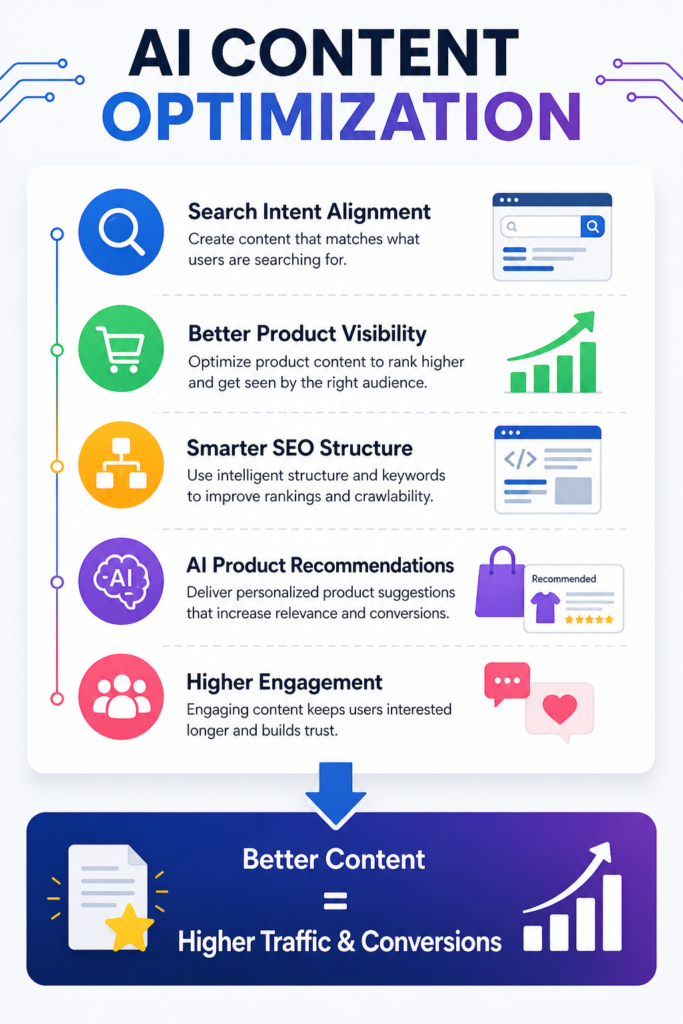
Why Is Your Content Not Working?
I once believed content quality alone was enough. Many marketers still quietly believe this. But content without alignment does not bring the desired traffic results.
The internet is very crowded. Millions of pages compete for attention every minute. Search engines no longer reward effort alone; they reward relevance and usefulness.
Several reasons quietly damage content performance.
Lack of Focus on Search Intent
Content fails when it does not understand the search intent of the customer. Keywords alone are not enough anymore. A user searching “best running shoes for flat feet” could be expecting guidance and recommendations. If he gets a generic explanation about shoe manufacturing, he would just move on.
I once wrote a long article heavily optimized with keywords like “content optimization tools” and “PDP optimization.” Technically, it looked perfect. But the traffic behaved strangely. Visitors arrived and disappeared quickly. The article answered the wrong question. Users wanted solutions, not theory.
AI-powered ecommerce SEO and content services now analyze intent patterns more deeply. They examine what users expect emotionally and practically when typing search queries. This changes how content must be written.
Poor On-Page SEO
Even exceptional content can remain hidden if technical SEO elements are ignored. Meta titles, image alt text, headers, internal links, and structured formatting have their own influence on visibility.
Search engines look for structural clarity before they approve of any content quality. Many businesses feel this part is not important because it feels invisible to readers. But algorithms notice everything.
Well-optimized pages often experience stronger click-through rates and improved rankings because search engines understand them more clearly.
Thin or Outdated Content
Like all of us, content ages too. A page that performed brilliantly two years ago may slowly fade without giving any obvious warning signs.
I once depended heavily on evergreen content and ignored updates for months. Traffic declined slowly but continuously because competitors refreshed their pages more aggressively. Eventually, entire sections needed restructuring.
Search engines now prefer freshness. This is especially true in fast-changing industries like eCommerce and AI-driven retail.

How AI Content Optimization Tools for eCommerce Product Pages Fix It
AI has changed content optimization. Earlier, what used to be guesswork has now changed into a structured analysis. Modern AI content optimization tools for eCommerce product pages now study readability, keyword intent, competitor performance, engagement signals, and even emotional tone, and they do it simultaneously.
This creates a more intelligent approach to optimization.
Content Intelligence Tools
Content intelligence systems examine why content underperforms rather than simply identifying missing keywords.
These tools evaluate:
- Readability patterns
- User engagement signals
- Content depth
- Semantic keyword relationships
- Search intent alignment
- Competitor gaps
Platforms like MarketMuse and Surfer SEO have transformed how eCommerce SEO and content services operate. They identify opportunities hidden inside existing content structures.
I personally witnessed traffic growth after restructuring content based on semantic recommendations rather than keyword density alone. The results felt surprisingly fast.
AI Enhanced Product Details Page SEO Tools
Product pages are often ignored in content strategy discussions. This is strange because they generate revenue directly.
AI enhanced product details page SEO tools now optimize product descriptions dynamically by analyzing buyer behavior, search visibility, and conversion patterns.
These systems improve:
- Product titles
- Structured formatting
- Internal linking
- Feature prioritization
- Conversion-focused descriptions
- Mobile readability
They also identify weak sections where users commonly abandon pages.
This matters because product page SEO and visibility optimization directly influence eCommerce revenue growth. A hidden product page cannot sell effectively regardless of product quality.
eCommerce SEO and Content Services are Changing
The old version of SEO focused heavily on keywords. The newer version focuses on usefulness and behavioral satisfaction.
Modern eCommerce content optimization services now combine:
- AI-driven analysis
- User intent mapping
- Behavioral tracking
- Content clustering
- Predictive optimization
- Automated SEO auditing
This shift is reshaping digital eCommerce marketing services entirely. AI systems can now predict which content structures perform best based on industry patterns. They identify readability fatigue and weak transitions automatically. They also locate missing semantic relationships automatically.
Instead of replacing human creativity, it sharpens it.
The interesting thing is how quietly this transformation happened. AI entered content strategy gradually rather than dramatically. Yet now, many successful eCommerce brands depend heavily on AI-assisted optimization workflows daily.

The Rise of AI Enhanced Product Details Page SEO Tools
Product detail pages have evolved from simple descriptions into strategic conversion environments.
You have AI enhanced product details page SEO tools that are effective in optimizing pages in ways that were nearly impossible manually a few years ago.
Some systems can automatically:
- Rewrite low-performing product descriptions
- Suggest stronger keyword structures
- Improve readability
- Generate FAQ sections
- Detect missing metadata
- Analyze customer sentiment
This is especially valuable for large eCommerce stores managing thousands of products simultaneously.
AI systems also improve consistency. One major issue in eCommerce is uneven product presentation across catalogs. Some pages feel detailed while others appear incomplete. AI-driven optimization helps standardize quality.
The Hidden Problem With Thin Content
Thin content remains one of the most underestimated SEO problems.
Many pages appear informative on the surface but fail to provide depth or practical value. Search engines recognize this increasingly well. Customers also recognize it instinctively. They leave quickly when content feels repetitive or shallow.
Modern eCommerce SEO and content services now prioritize content richness rather than word count alone.
Rich content includes:
- Helpful comparisons
- Clear explanations
- Buyer guidance
- FAQs
- Structured formatting
- Contextual insights
This improves engagement and lowers bounce rates naturally.
Why Product Page SEO and Visibility Optimization Matters
Product pages are often treated as technical necessities instead of sales assets. This is a costly mistake.
Strong product page SEO and visibility optimization help products rank independently within search engines. This increases organic discovery dramatically.
Optimized pages also improve:
- Click-through rates
- Customer trust
- Conversion rates
- Session duration
- Revenue consistency
AI-powered systems now help businesses monitor product page performance continuously instead of reacting after traffic declines.
This creates a much more proactive eCommerce strategy.

Frequently Asked Questions (FAQs)
1. What are eCommerce content optimization services?
These are services that improve content structure, SEO performance, readability, and user engagement to increase traffic and conversions.
2. How do AI content optimization tools for eCommerce product pages help?
They analyze keywords, user behavior, readability, and competitor strategies to improve visibility and conversions.
3. Why is search intent important in eCommerce SEO?
Search intent helps content align with what users actually expect. They improve engagement and reduce bounce rates.
4. Can AI enhanced product details page SEO tools improve sales?
Yes. Better optimized product pages often lead to stronger visibility, trust, and higher conversion rates.
5. How often should eCommerce content be updated?
Content should be reviewed regularly, especially for competitive industries or changing search trends.
Conclusion
Content failure rarely happens because of bad writing alone. It happens usually because content lacks alignment, structure, freshness, or visibility.
AI is reshaping how businesses approach optimization. Not by removing human creativity, but by exposing patterns humans often miss. eCommerce brands that combine strong writing with intelligent optimization systems are steadily building stronger visibility and consistent growth.
Is Your Ecommerce Content Quietly Losing Visibility?
Strong content deserves more than accidental discovery. Modern eCommerce growth depends on intelligent optimization, structured product pages, and AI-powered visibility. Merchmetric helps you to grow and evolve with customer behavior.
Optimize smarter and grow faster with Merchmetric.
Suggested Reads
- Smarter banner strategies improving engagement and conversion performance
- Practical PDP optimization methods increasing measurable ecommerce conversions
- Helpful tools simplifying multi-channel marketplace PDP content optimization
- Understanding product title optimization versus visual A/B testing performance


