
PDP in Marketing: How Product Detail Pages Drive Ecommerce Revenue and Conversions
 AI Summary Tools





Last updated on July 27th, 2026
If you are spending thousands of dollars monthly on premium social media ads, paid search campaigns, and influencer partnerships only to send that traffic to a cluttered, unoptimized product page, you are actively subsidizing your store’s high bounce rates.
The foundational anatomy of digital commerce has shifted permanently. Historically, brands viewed the product page as a digital catalog card, a basic space to list dimensions, inventory counts, and base prices. Today, this framework is entirely obsolete. Every single marketing dollar you deploy across top-of-funnel acquisition channels ultimately relies on a single metric: your product page’s structural ability to convince a browser to click “Add to Cart.”
Transitioning from basic information logging to data-backed PDP optimisation ensures your traffic encounters clear value propositions, engaging visual storytelling, and seamless checkout paths. This complete guide breaks down the core conversion components, customer journey alignments, and automated artificial intelligence frameworks required to turn your product pages into high-converting storefronts.
Table of Contents
Why PDPs Have Become the Most Important Landing Pages in Marketing
The Role of PDPs Across the Customer Journey
How PDPs Directly Influence Revenue
Essential Components of a Revenue-Driving PDP
AI Is Transforming PDP Marketing
Common Marketing Mistakes That Hurt PDP Performance
Measuring PDP Marketing Success
What Is a PDP in Ecommerce?
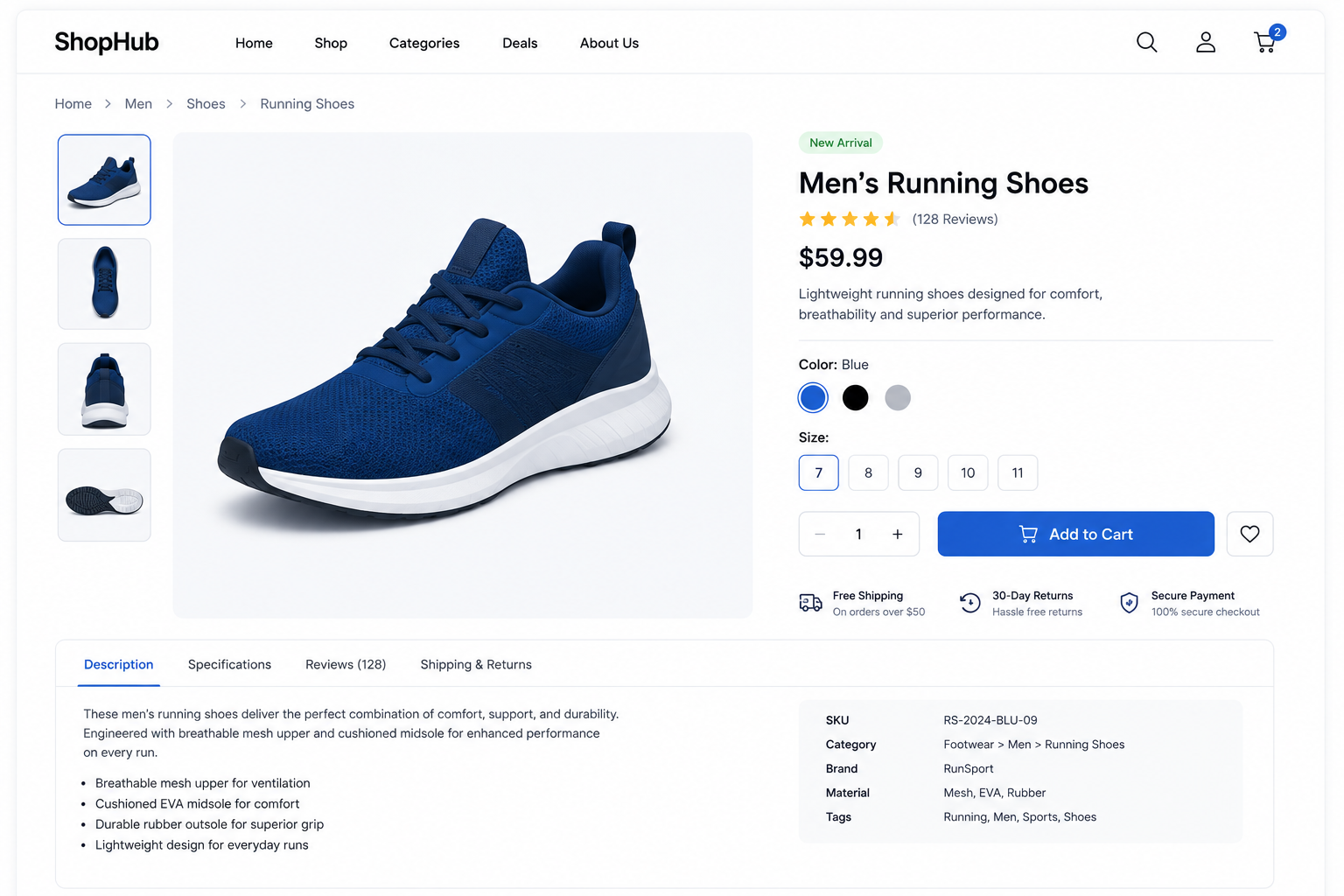
A Product Detail Page (PDP) is a dedicated webpage on an e-commerce platform that displays the complete technical specifications, marketing descriptions, media assets, pricing variables, and fulfillment options for a single specific item. It serves as the definitive point of purchase for online consumers.
Turn casual social browsers into buyers with the right marketing strategy.
A modern, high-converting PDP consists of several critical functional elements: the product title and clear pricing structure, high-resolution media galleries with zoom functionalities, drop-down variation selectors (for size, color, or material), clear stock availability badges, and a prominent call-to-action (CTA).
It is important to differentiate the PDP from the Product Listing Page (PLP). While a PLP serves as a broad category directory or search results view designed to help users browse, filter, and compare multiple items simultaneously, the PDP is a hyper-focused space built entirely to drive a single product decision.
Why PDPs Have Become the Most Important Landing Pages in Marketing
The modern digital marketing ecosystem bypasses traditional homepage funnels entirely. Every prominent acquisition channel routes traffic directly to the individual product page level:
- Organic Search: Search engines index rich product listings, pulling high-intent shoppers straight from query bars to your item descriptions.
- Google Shopping: Product Listing Ads (PLAs) display specific item pricing, pictures, and ratings, bypassing your homepage entirely.
- Paid Search & Social: Targeted Meta, TikTok, and Google Ads link users directly to the specific featured SKU to minimize checkout friction.
- Email & Influencer Campaigns: Direct links in weekly newsletters or influencer promo codes drop consumers directly onto matching product detail variants.
Because every marketing channel funnels traffic directly to this point, the PDP in marketing has effectively become your brand’s core landing page ecosystem. If the page fails to convert, your entire preceding marketing funnel breaks down.
The Role of PDPs Across the Customer Journey
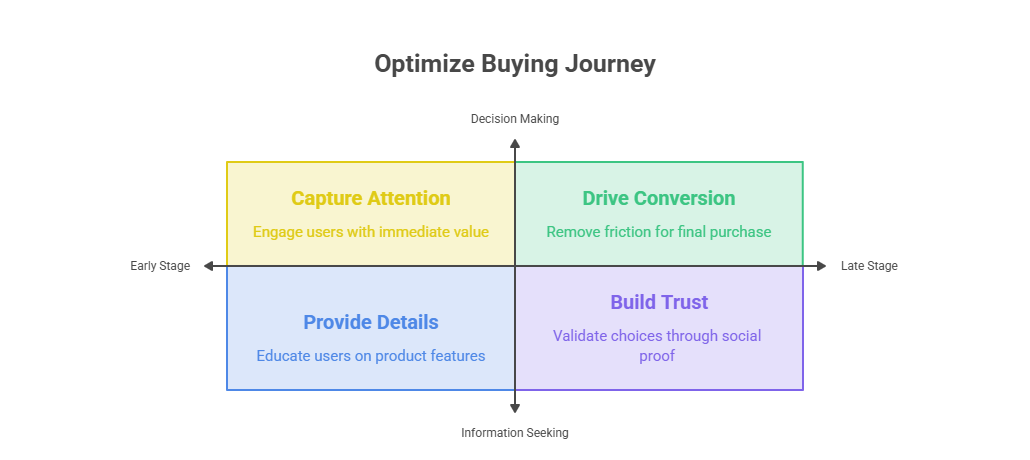
A properly optimized product detail page must support users across every stage of the classic buying cycle:
- Awareness: Capturing immediate attention through strong hero imagery, clear branding, and a compelling above-the-fold value proposition.
- Consideration: Providing detailed feature breakdowns, material transparent sheets, and usage benefits to address immediate user needs.
- Evaluation: Using rich social proof, verified buyer reviews, and comparison matrices to answer common user questions and build trust.
- Purchase: Removing all transaction friction through prominent Add-to-Cart buttons, multiple payment options, and transparent delivery dates.
- Post-purchase: Displaying clear warranty details, care documentation, and return parameters to support long-term retention.
How PDPs Directly Influence Revenue
Implementing continuous PDP optimisation strategies improves your conversion metrics and directly accelerates top-line business growth across several key metrics:
- Improves Conversion Rates: Clarifying the value proposition and simplifying design features converts passive website browsers into active buyers more efficiently.
- Increases Average Order Value (AOV): Integrating smart product recommendation modules encourages shoppers to add complementary accessories or bundle options before checking out.
- Reduces Cart Abandonment: Displaying clear shipping rates, total costs, and delivery windows early removes the unexpected fees that cause users to exit the checkout path.
- Lowers Return Rates: Providing complete sizing charts, material breakdowns, and accurate descriptions ensures buyers receive exactly what they expect, cutting down on returns.
Essential Components of a Revenue-Driving PDP
To drive consistent sales, your page layout should keep these critical sections clean, clear, and highly scannable:
- High-Quality Content: Craft unique, benefit-focused product copy that explains how the item solves a specific consumer problem, rather than relying on dry manufacturer descriptions.
- Visual Storytelling: Deploy high-definition lifestyle galleries, 360-degree interactive spin views, and video loops showing the product in active use.
- Trust Signals: Place secure checkout badges, clear warranty logos, and explicit return policies near the purchase button to reassure hesitant buyers.
- Technical Specifications: Organize sizing metrics, material dimensions, ingredients, and compatibility requirements into structured, scannable accordions.
- Social Proof: Highlight aggregate star ratings, filterable user reviews, and authentic customer-submitted product photos.
- Mobile-First Design: Ensure sticky Add-to-Cart bars, rapid image swipe controls, and touch-friendly interface elements perform smoothly on mobile screens.
- Personalization: Show dynamic cross-sell recommendations and tailored messaging based on a visitor’s past browsing behavior.
- Clear Calls-to-Action: Design prominent, high-contrast checkout buttons that remain easily accessible as the user scrolls down the page.
AI Is Transforming PDP Marketing
Artificial intelligence systems are completely redefining how brands build and continuously improve their product pages at scale:
Automated Content Generation
Advanced language models can write unique, search-optimized product descriptions, pull out key feature highlights, and generate accurate SEO metadata across thousands of SKUs instantly, keeping your catalog fresh and searchable.
Dynamic Personalization
AI data engines analyze a visitor’s real-time browsing patterns to show personalized product recommendations, adjust featured benefits based on user interests, and surface targeted promotional offers to increase conversion rates.
Visual Optimization Tools
Smart imagery software can automatically remove distracting photo backgrounds, generate lifestyle mockups from basic studio shots, and create localized product videos to enhance visual storytelling.
Predictive Optimization
Automated testing tools run non-stop, background A/B experiments on headings, button colors, and layout structures, using predictive analytics to optimize conversions without manual design updates.
Common Marketing Mistakes That Hurt PDP Performance
- Treating the page as a static repository for technical specs rather than an active marketing landing page.
- Burying the primary value proposition beneath large code blocks or long, unstructured blocks of text.
- Relying on generic, duplicate manufacturer descriptions that fail to build brand authority or rank on search engines.
- Neglecting mobile layout optimization results in tiny text lines, misaligned images, and clunky checkout steps.
- Hiding your shipping costs and return policies inside distant footer menus, which creates buyer hesitation.
Measuring PDP Marketing Success
To verify the financial return of your optimization efforts, your growth teams must continuously track these core performance metrics:
|
Key Performance Indicator (KPI) |
Operational Tracking Definition |
Target Growth Benchmark |
| Product Conversion Rate | The percentage of page visitors who complete a purchase | 2.5% to 4.5% baseline |
| Add-to-Cart Rate | The percentage of visitors who add the item to their checkout basket | 8.0% to 12.0% target range |
| Revenue per Visitor (RPV) | Total sales revenue divided by unique product page sessions | Positive upward trend line |
| Average Scroll Depth | How far down the product details page does a user navigate | Minimum 50% depth profile |
| Exit Rate | The percentage of users who close their browsing session from the PDP | Keep below 35% thresholds |
Future Trends in PDP Marketing
The future of digital retail points toward highly immersive, autonomous product experiences. Static image grids are rapidly making way for interactive, browser-based augmented reality (AR) tools that allow consumers to view products directly inside their own homes before buying.
Furthermore, conversational AI assistants are moving past simple chat widgets to become personalized shopping concierges. These integrated tools answer specific product questions, compare variant details, and process transactions right on the page, creating a fast, friction-free shopping experience.
Conclusion
In modern digital retail, the PDP in marketing is no longer just a destination for displaying basic product data. It functions as the critical junction where your traffic, ad spend, and brand storytelling translate into real-time business revenue.
By applying systematic PDP optimization techniques, such as structuring clean product data, highlighting strong social proof, and integrating smart personalization engines, your brand can turn casual website traffic into a loyal, high-converting customer base that drives long-term profitability.
Partnering with an experienced optimization specialist is the most effective way to protect your marketing margins and grow your catalog. If you are ready to remove data discrepancies, optimize your multi-channel digital assets, and build high-converting storefronts, connect with the data engineering team at MerchMetric to launch your optimization audit today.