

How to Boost Your Search Rankings with Product Title Optimization Strategies
Last updated on December 26th, 2025
When you are an e-commerce business owner, you have to outshine thousands of competing listings. This already gives you the sense of how powerful product title optimization can be. In the crowded digital marketplace, the humble product title often becomes the silent negotiator. It persuades search engines, algorithmic guardians, and hurried shoppers to pay attention. With the right blend of clarity, keyword focus, and product data optimization, your listings can climb higher. They can gain visibility and convert more frequently.
Below, you’ll discover the essence, importance, and practical strategies behind product title optimization.
Table of Contents
What is Product Title Optimization?
Why is Product Title Optimization Important?
Strategies for Product Title Optimization
Utilize Product Listing Optimization Services
What is Product Title Optimization?
Product title optimization is a crucial craft in eCommerce. It is the art of shaping your product titles. It is done in a way that search engines understand them instantly, and shoppers feel drawn to them at a glance. When your titles align with real-world search habits, relevant keywords, and appropriately structured product data, you unlock stronger visibility and smoother discoverability.
At its core, this process is about making your titles quite easy for search engines to index and delightful for humans to read. For this, you have to pair an optimized structure with product data optimization principles. You help your listings on platforms like Amazon, Shopify, and Google Shopping perform far better.

Why is Product Title Optimization Important?
Product title optimization matters more than many store owners realize. In fact, it quietly dictates how your product dances through search results.
- Improved visibility: Search engines can easily process clean and relevant titles. When you optimize them, you push your products closer to those first-page results you are aiming for.
- Higher search rankings: Through accurate keywords and refined structure, you help search engines grasp your product’s essence. This then boosts the likelihood of top placements.
- Increased click-through rates: Shoppers love clarity. A crisp, well-formed title dramatically increases the chances that consumers will click and eventually buy.
- Better conversions: Clear titles reduce confusion. When customers instantly understand what you sell, they convert with far fewer hesitations.
Product title optimization is not merely a “labeling exercise.” It’s a tactic to increase revenue by strengthening the very architecture of your product listings.
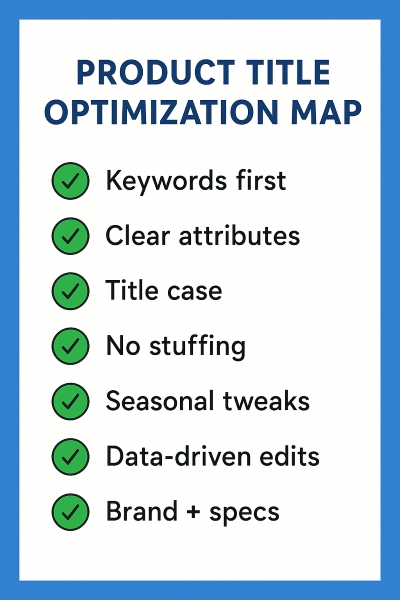
Strategies for Product Title Optimization
Let’s uncover some unexpectedly powerful tactics that can elevate your search presence. They are all rooted in product title optimization, product data optimization, and structured listing methodology.
1. Include Relevant Keywords
Keywords are the skeletal framework of your product titles. Conduct keyword research and examine competitor listings. Look out for search terms your audience commonly uses. Then integrate these naturally to avoid robotic phrasing.
2. Keep It Concise And Descriptive
A title must be just right in size. If it’s too long, the meaning is diluted. If it’s too short, context slips away. Strike a balance by focusing only on critical attributes and eliminating unnecessary words.
3. Use Title Case
Title Case enhances readability and visual appeal. Each significant word stands proudly, giving your title a more authoritative presence.
4. Avoid Keyword Stuffing
Stuffing keywords can be quite the fastest way to scare both algorithms and shoppers. Search engines prefer natural, flowing language. It is best to keep things human.
5. Incorporate Brand And Manufacturer Information
If your audience searches by brand, adding it to your title reinforces trust. It improves search alignment. Always place brand names strategically near the beginning.
6. Specify Important Attributes
Color, size, material, capacity, and such details matter. Attributes also help platforms categorize your product more accurately.
7. Utilize Natural Language And Phrasing
Product title optimization means mirroring customer behavior. If shoppers search conversationally, your titles should echo the same rhythm.
8. Leverage Numerical Information
Model numbers, version numbers, measurements, quantities, and such numbers attract the eye. This is because they communicate precision instantly.

9. Prioritize Keyword Placement
Place primary keywords at the beginning whenever possible. Search engines weigh early words more heavily.
10. Consider Seasonality And Trends
A trending keyword sprinkled into a title at the right moment can skyrocket visibility instantly. Adjust based on seasonal demand cycles.
11. Monitor And Adapt Based On Performance Data
Through A/B testing and product data optimization, evaluate which titles perform best. Keep refining based on real-world metrics.
12. Follow Platform Guidelines
Every marketplace, be it Amazon, Etsy, Walmart, or any other, has specific formatting rules. Never violate them, or the platform may suppress your listing.
Utilize Product Listing Optimization Services
Not every e-commerce business has the time or resources to manage product title optimization or product data optimization internally. In such cases, they can partner with product listing optimization services and product listing services to handle these tasks.
These professional services analyze your product structure and keyword gaps. They look at search behavior patterns, competitive landscapes, and listing weaknesses. They refine titles, attributes, descriptions, and metadata. This will help to maximize rankings. If optimization feels overwhelming, outsourcing the process ensures consistent quality and predictable results.

FAQs
1. What is the main purpose of product title optimization?
The main purpose is to improve visibility and rankings. This is done by making product titles more relevant, searchable, and user-friendly.
2. How can product data optimization help my online store?
Product data optimization ensures your titles, descriptions, and attributes are structured correctly. As a result, search engines and shoppers understand your product instantly.
3. Are product listing optimization services worth investing in?
Yes, especially for stores with large catalogs. They help maintain accuracy, consistency, and keyword strength across all listings.
4. How often should I update my product titles?
Update them whenever search trends shift and product attributes change. When performance metrics dip, it is best to update your title.
5. Can optimized titles increase sales directly?
Yes. Higher visibility leads to more clicks, and clearer titles reduce friction. They ultimately increase conversions.
Conclusion
Product title optimization is far more powerful than its unassuming name suggests. Here, you need to combine strong keyword choices, platform-friendly formatting, deep product data optimization, and insight-driven adjustments. This will help your product listings rise higher and convert better. With tools and support from advanced platforms like Merchmetric, your listings can carry sharper clarity, stronger relevance, and improved marketplace performance.
Ready to optimize your product titles with precision and data-driven insights?
Merchmetric brings AI-powered product listing optimization services, automated content enhancements, and deep analytics. They are all designed to help your listings shine brighter and rank higher.
Explore Merchmetric’s intelligent optimization platform today.
Suggested Reads
https://www.merchmetric.com/blog/pdp-optimization-subscription-ecommerce/ – Quick take: How subscription brands can perfect PDP journeys.
https://www.merchmetric.com/blog/ai-product-content-optimization-ecommerce/ – Quick take: AI-driven methods to sharpen ecommerce product content.
https://www.merchmetric.com/blog/seo-optimized-product-listings-success/ – Quick take: Practical SEO frameworks to boost listing performance.
https://www.merchmetric.com/blog/pstandardizing-data-for-net-zero-goals/ – Quick take: Why clean product data matters for sustainable operations.

Anne Davis
Anne Davis, with a 19-year career at Vserve Ebusiness Solutions, currently leads as the Director of Sales and Marketing. Specializing in the eCommerce sector, she focuses on client relations, social media marketing, and email campaigns. Anne is dedicated to driving business growth in the digital space, utilizing her deep understanding of customer needs and market trends.