
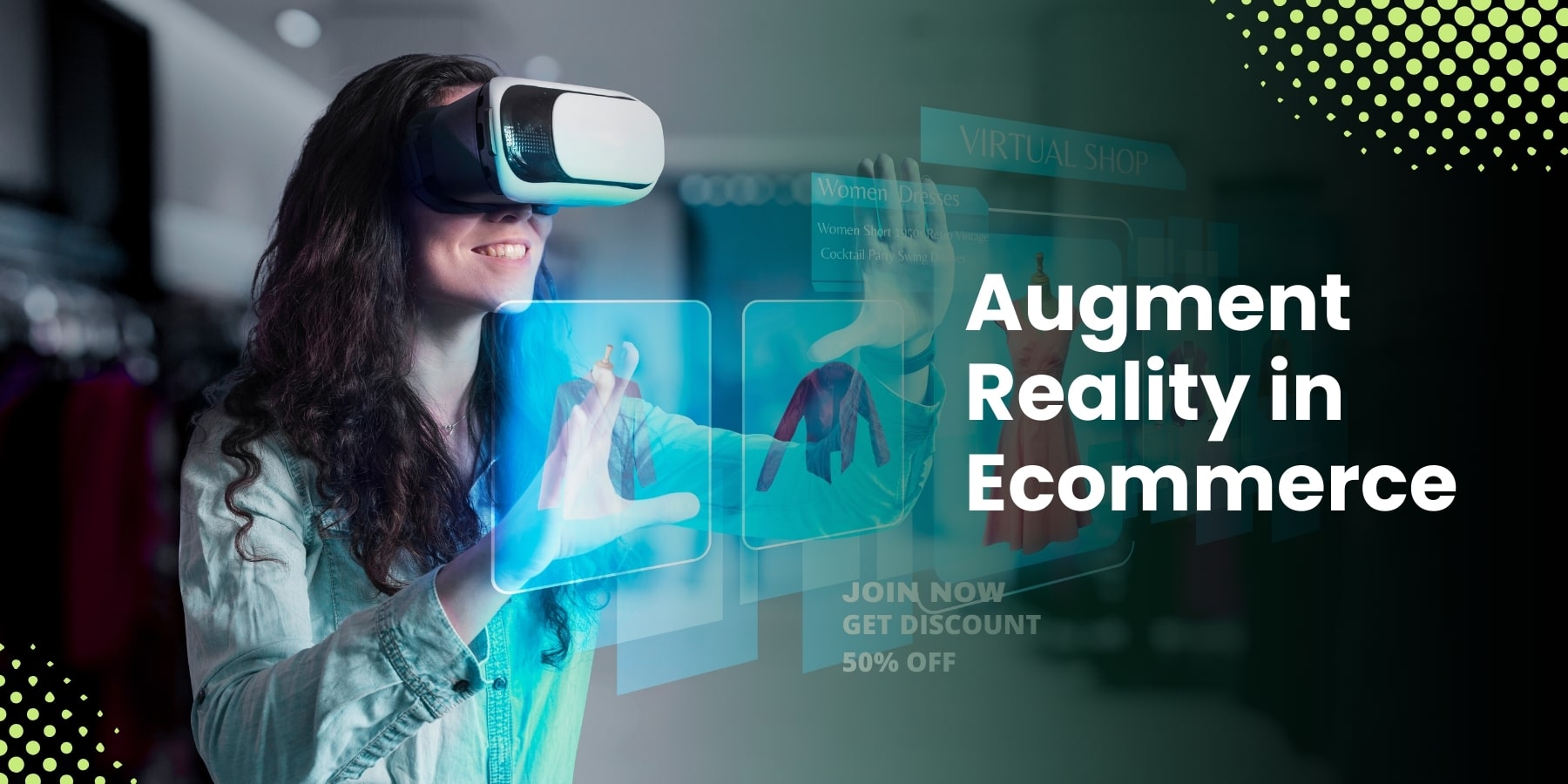
Augmented Reality: The Game-Changer for Online Shopping Experiences
Last updated on January 6th, 2026
Today, integrating augmented reality in eCommerce and retail in 2026 is no longer a shiny experiment. It is routine, expected, and quietly powerful. Brands that once tested AR for fun now depend on it for conversions, clarity, and customer confidence.
As someone who closely watches technology mature, wobble, and then suddenly stabilize, I’ve seen augmented reality in online shopping move from novelty to necessity. In 2026, AR is faster, lighter, and far more human. Devices are better, and platforms are smart and ready for impatient but curious shoppers. This blend of readiness and realism has turned AR for eCommerce into a serious growth lever.
Shopping online no longer feels flat. It responds and listens. That is the magic of augmented reality.
Table of Contents
Understanding Augmented Reality in E-commerce
The Transformative Impact of AR on Online Shopping
AR Content Creation for E-commerce
Real-World Applications of Augmented Reality in Retail and Virtual Reality in Retail
AR for E-commerce: Driving Growth and Engagement in 2025
The Challenges and Future of AR in E-commerce and Retail
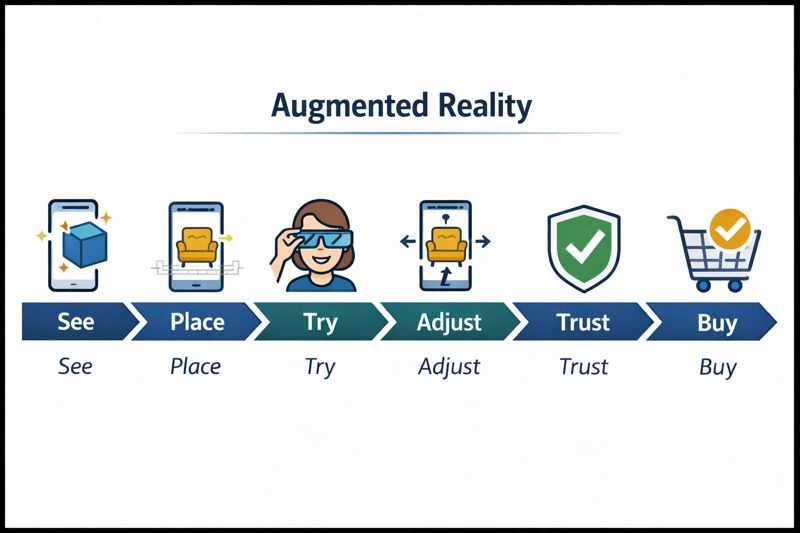
Understanding Augmented Reality in E-commerce
At its core, augmented reality in eCommerce allows customers to see products in their own world before buying. It is not imagined or guessed but seen. By 2026, AR systems are deeply paired with AI, allowing instant customization, realistic scaling, and near-perfect lighting simulation.
This blend of digital overlays and physical environments makes AR eCommerce experiences feel less like browsing and more like testing. You don’t scroll past a product anymore. You invite it into your space.
What Is Augmented Reality in eCommerce?
Augmented reality places digital objects, such as images, animations, data, into the real world through devices like smartphones, tablets, and AR glasses. In 2026, this is seamless. No heavy apps or friction. Customers can see a sofa in their living room or a watch on their wrist within seconds.
Unlike virtual reality eCommerce, which creates a fully digital world, AR enhances the real one. That difference matters, and AR feels practical. VR feels immersive. Both are useful, but AR wins in everyday shopping.
The Rise of AR Online Shopping
The demand for realism pushed AR forward. In 2025, over 60% of online shoppers interact with some form of augmented reality in online shopping. Major platforms now embed AR by default. What was once optional is now expected, especially in fashion, furniture, beauty, and electronics.

The Transformative Impact of AR on Online Shopping
AR for eCommerce solves real problems.
Enhanced Product Visualization
Customers can rotate products, resize them, and view them under real lighting. Furniture fits and glasses alignment can be studied. Makeup shades behave realistically. By 2026, real-time 3D rendering has made this experience almost tactile.
Reduced Return Rates
Yes, augmented reality helps reduce returns. When customers know what they are getting, they hesitate less and regret less. Retailers using AR report fewer size-related and expectation-related returns.
Personalized Shopping Experiences
AI-powered AR eCommerce tools now adapt in real time. What customers view, how long they interact, and what they adjust all shape future recommendations. Shopping becomes personal without being intrusive.
AR Content Creation for E-commerce and Virtual Reality eCommerce
Strong technology fails without good content. AR content creation for eCommerce is where success quietly lives.
Understand Your Audience
What do they want to see? Size accuracy, texture detail, or movement? In 2026, AR analytics show how users interact with virtual products, allowing brands to refine content continuously.
Invest in Quality Design
Cheap AR feels fake. Good AR feels honest. High-quality models, proper scaling, and smooth motion separate useful experiences from ignored ones.
Seamless Integration
Augmented reality for online shopping should feel like part of the product page, not a side quest. When augmented reality in eCommerce is integrated cleanly, usage rises naturally.

Real-World Applications of Augmented Reality in Retail and Virtual Reality in Retail
Augmented reality in retail doesn’t stop online. Physical stores are evolving too.
Virtual Try-Ons
Try it with clothing, shoes, eyewear, cosmetics. AR mirrors and mobile apps allow instant try-ons. In 2026, full-body scanning has made this remarkably accurate.
Interactive Product Information
Point a phone. See specs, reviews, and comparisons. AR turns shelves into storytellers.
In-Store Navigation
Large stores use AR overlays to guide customers. No wandering or frustration.
Meanwhile, virtual reality in retail is used for immersive brand experiences in virtual showrooms, digital flagship stores, and guided product tours. VR pulls customers into new worlds. AR improves the one they’re already in.
AR for E-commerce: Driving Growth and Engagement in 2026
In 2026, AR for eCommerce directly influences conversions. Interactive demos, virtual fitting rooms, and 3D previews keep users engaged longer and buying with more confidence.
Retailers now analyze AR interaction data to predict preferences, optimize layouts, and personalize journeys. Augmented reality in eCommerce has become both a sales tool and an insight engine.
Leading Augmented Reality Platforms Used in eCommerce
Some widely adopted platforms include ARKit, ARCore, WebAR solutions, and platform-native tools built into major eCommerce systems. These platforms make augmented reality eCommerce content creation faster to deploy and easier to scale.
eCommerce Companies Pioneering Augmented Reality
Brands in furniture, beauty, and fashion lead the way when it comes to augmented reality content creation for eCommerce. They use augmented reality in online shopping to let customers try before they buy, digitally but convincingly.
How Augmented Reality Enhances Customer Engagement
Augmented reality for online shopping slows users down in a good way. They explore and interact. They feel involved. Engagement rises because the experience feels participatory, not passive.
The Challenges and Future of AR in E-commerce and Retail
Challenges remain. Development costs. Device limitations. Learning curves. But in 2026, cloud-based AR and low-code tools are lowering these barriers fast.
The future points toward deeper AI integration, social commerce overlays, and hybrid virtual reality eCommerce environments. AR will become quieter, smoother, and more invisible—while doing more work behind the scenes.
FAQs
1. What is augmented reality in eCommerce?
Augmented reality content creation for eCommerce allows shoppers to view products in real-world settings using digital devices.
2. How does augmented reality improve online shopping?
It improves visualization, boosts confidence, and reduces returns.
3. Is augmented reality expensive for eCommerce brands?
Augmented reality eCommerce content creation costs have dropped significantly due to cloud and platform-based AR tools.
4. How is virtual reality eCommerce different from AR?
VR creates digital worlds, while AR enhances the real one.
5. Can small retailers use AR effectively?
Yes, modern AR platforms make adoption accessible even for smaller brands.
Conclusion
Augmented reality has quietly rewritten the rules of online shopping. It replaces doubt with clarity, distance with presence, and guesswork with understanding. In 2026, augmented reality in eCommerce is not about being futuristic. It is about being useful.
Brands that adopt AR thoughtfully don’t just sell more. They explain better, and they connect deeper. And they earn trust quietly.
Ready To Measure the Impact of AR on Your Product Pages?
Merchmetric helps you understand how shoppers interact, decide, and convert—across AR, PDPs, and beyond. Turn experience into insight.
Let AR guide your growth with Merchmetric.
Suggested Reads
- https://www.merchmetric.com/blog/top-10-eCommerce-market-intelligence-reports/ – Key intelligence reports shaping smarter eCommerce decisions
- https://www.merchmetric.com/blog/top-6-eCommerce-product-page-metrics/ – Essential metrics every high-performing product page tracks
- https://www.merchmetric.com/blog/the-next-generation-of-pdp-optimization/ – How modern PDP optimization boosts engagement and conversions
- https://www.merchmetric.com/blog/product-page-metrics-that-matter-5-kpis-that-predict-80-of-your-conversions/ – KPIs that accurately predict eCommerce conversion performance

Kimberly Morrison
Kimberly Morrison has been the Director of Client Relations at VGROW since 2019. She builds strong customer relationships, drives client retention, and oversees team productivity. Kimberly's approach to customer engagement is key to VGROW's aim of streamlining business processes through virtual assistance services.