
9 PDP Optimization Strategies That Actually Increase Conversions
Last updated on February 28th, 2026
A product detail page is a quiet room where doubt and desire sit together. When one wins, the other leaves. The difference is subtle and shaped by small, deliberate choices. They depend on words placed well, images arranged with care, and proof offered at the right time.
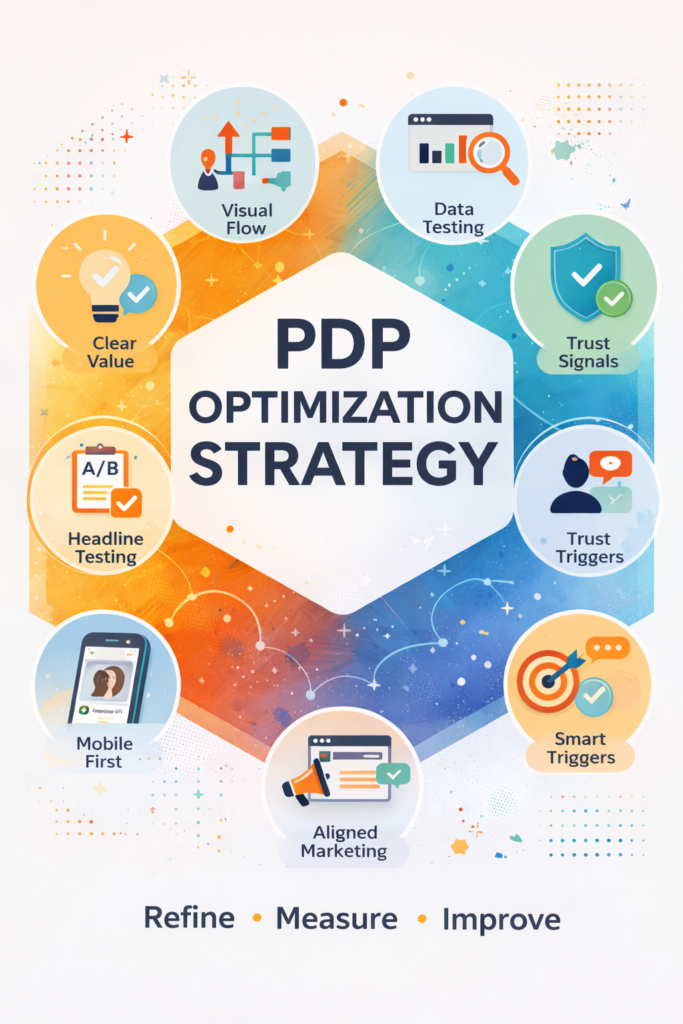
Many brands chase traffic, but few shape experience. This is where PDP optimization becomes essential. It is a discipline. A structured PDP optimization strategy aligns design, data, and intent. When product optimization meaning is fully understood, brands stop guessing and start refining. This blog outlines nine practical strategies that drive real PDP conversion optimization. They support PDP enrichment and turn simple PDP improvements into measurable growth.
Well-optimized product detail pages can achieve conversion rates as high as 8–10 %, significantly above the typical ecommerce average of around 2.86 %. This shows how important PDP improvements are for driving sales compared to general site conversion benchmarks.
Table of Contents

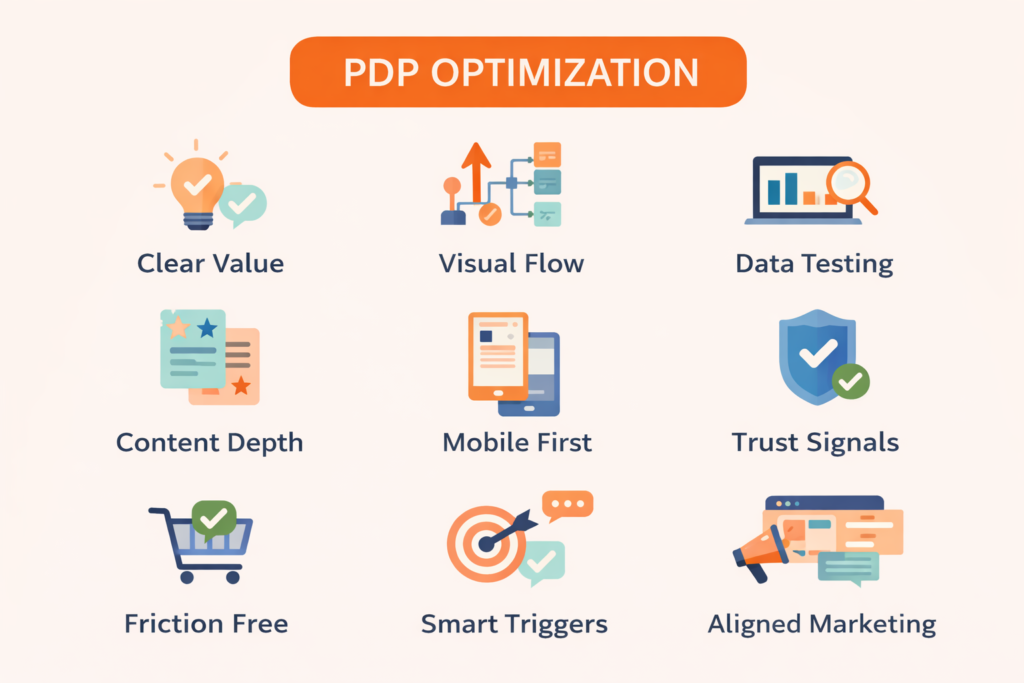
Understand Product Optimization Meaning Before You BeginStrategy 1: Start With Clear Value Positioning
Strategy 2: Strengthen Visual Hierarchy
Strategy 3: Use Data to Guide PDP Improvements
Strategy 4: Enhance Content Through PDP Enrichment
Strategy 5: Optimize for Mobile Without Compromise
Strategy 6: Build Trust Signals With Precision
Strategy 7: Simplify the Path to Purchase
Strategy 8: Use Behavioral Triggers Thoughtfully
Understand Product Optimization Meaning Before You Begin
Before applying tactics, clarity is required. Product optimization meaning is simple at its core. It is the process of improving every visible and invisible element of a product page to increase user confidence and action.
It includes layout, messaging, and performance speed. It includes testing. It is not one change but the habit of refinement. Without understanding this, PDP optimization becomes a scattered effort rather than a successful plan.
Strategy 1: Start With Clear Value Positioning
Visitors arrive with questions. What is this? Why should I care? Why now? Your headline must answer the first question instantly. Your subtext must answer the second. Your supporting points must answer the third.
A strong PDP optimization strategy begins with a promise. Be direct and specific, and avoid vague phrases. Value positioning shapes perception before the first scroll.
Strategy 2: Strengthen Visual Hierarchy
Design should guide the visitor effortlessly. The eye should move naturally from product image to title to price to call to action. When the layout lacks hierarchy, confusion grows in the mind of the consumer. This confusion reduces PDP conversion optimization.
Simple spacing, balanced typography, and clear contrast work positively with the consumer. These are small adjustments that deliver meaningful PDP improvements.
Strategy 3: Use Data to Guide PDP Improvements
Data can give you direction. Use it along with your instincts. Monitor engagement metrics, and track scroll behavior. Study add-to-cart patterns. Effective PDP optimization depends on measurement. Small experiments often reveal large opportunities.
When decisions are made based on data, PDP improvements become intentional rather than emotional. This builds consistency over time.
Strategy 4: Enhance Content Through PDP Enrichment
Basic descriptions inform, and enriched descriptions persuade. PDP enrichment can be done with detailed specifications, comparison charts, usage guides, and lifestyle imagery. It takes care of the objections before they become exits from the webpage.
Content depth, when done well, increases conversion. When information feels complete, hesitation decreases. This is a quiet but powerful PDP conversion optimization.
Strategy 5: Optimize for Mobile Without Compromise
Most users now browse through smaller screens. Mobile experience must not feel secondary. Text should be readable, and buttons should be accessible. Images should load quickly.
A broken mobile layout reduces confidence instantly. Mobile-first thinking is the first step of a PDP optimization strategy. It is essential.
Strategy 6: Build Trust Signals With Precision
Trust is built through signals. It is built slowly through verified reviews, clear return policies, secure payment icons, and delivery transparency.
These elements may seem small. Yet they anchor buyer confidence. Effective PDP marketing integrates trust markers seamlessly into the layout rather than placing them as afterthoughts.
Strategy 7: Simplify the Path to Purchase
Complex checkout paths destroy intention. Limit unnecessary fields, and reduce any distractions near the call to action. Highlight shipping clarity early.
The goal of PDP conversion optimization is not to add more elements. It is to remove friction. Each additional barrier reduces that probability.
Strategy 8: Use Behavioral Triggers Thoughtfully
Behavioral cues influence action, but they must be subtle. Use low stock indicators, limited time discounts, and real-time purchase notifications.
When used responsibly, these cues support urgency without pressure. They can improve PDP conversion optimization by encouraging timely decisions.
Strategy 9: Align PDP Marketing With Page Experience
The traffic source and page message must align. If an ad promises premium quality, the product page must reinforce that promise. If a campaign highlights affordability, price transparency must be visible immediately.
Misalignment reduces trust, but alignment strengthens continuity. Strong PDP marketing is not separate from PDP optimization. It is integrated.

FAQs
1. What is PDP optimization?
PDP optimization is the structured process of improving product detail pages. The aim is to increase engagement and conversions.
2. How does PDP enrichment improve conversions?
PDP enrichment adds deeper product information and visuals. This information reduces uncertainty and increases buyer confidence.
3. What is a good PDP conversion optimization approach?
A good approach combines data analysis, testing, design refinement, and messaging clarity.
4. How often should PDP improvements be tested?
Continuous testing is recommended. This is particularly helpful during product launches and seasonal campaigns.
5. Does PDP marketing influence conversion rates?
Yes. When marketing messages align with page content, user trust increases, supporting stronger conversions.
Conclusion
PDP optimization is not a one-time task. It is a discipline that rewards patience. Each element on a product page carries weight. Some are meant to be loud, and some are meant to be soft. Together, they shape the final decision.
A thoughtful PDP optimization strategy blends clarity, design, enrichment, and testing. It transforms scattered updates into deliberate PDP improvements. When brands treat PDP conversion optimization as a structured practice, they do not rely on luck. They rely on refinement.
Are you ready to turn your product pages into consistent conversion engines?
Merchmetric helps you uncover the hidden gaps in your product pages and guides your PDP optimization with real performance insights.
Suggested Reads
https://www.merchmetric.com/blog/transforming-browsers-into-buyers-techniques-for-product-page-conversion-success/ – A guide to practical methods that convert casual visitors into committed buyers.
https://www.merchmetric.com/blog/conversion-mastery-how-to-increase-your-ecommerce-sites-conversion-rate/ – An in-depth look at strategies to systematically increase ecommerce conversion rates.
https://www.merchmetric.com/blog/how-to-maximize-your-online-stores-potential-with-conversion-optimization/ – A detailed explanation of how structured optimization improves overall store performance.
https://www.merchmetric.com/blog/why-is-your-product-page-conversion-rate-low-5-common-mistakes-to-avoid/ – An analysis of common product page mistakes that limit conversion potential.


