

Why Is Your Product Page Conversion Rate Low? 5 Common Mistakes to Avoid
 AI Summary Tools





Last updated on December 26th, 2025
When it comes to steering an eCommerce store toward steady sales, nothing guides you better than your product page conversion rate This is a quirky little metric that reveals the percentage of visitors who land on a product page and then magically decide to buy. A strong PDP conversion rate means your pages are doing their job quite well. A weak one? That usually signals hidden cracks waiting to be repaired. And sometimes, those cracks are tiny but mighty enough to drain revenue like a slow leak.
Did you know that the global average eCommerce conversion rate (2025) is around 2%–4%. Below, we explore the common blunders that lie low inside product pages and hurt your eCommerce product page metrics. We also talk about how you can banish them with thoughtful product page conversion optimization.
Table of Contents
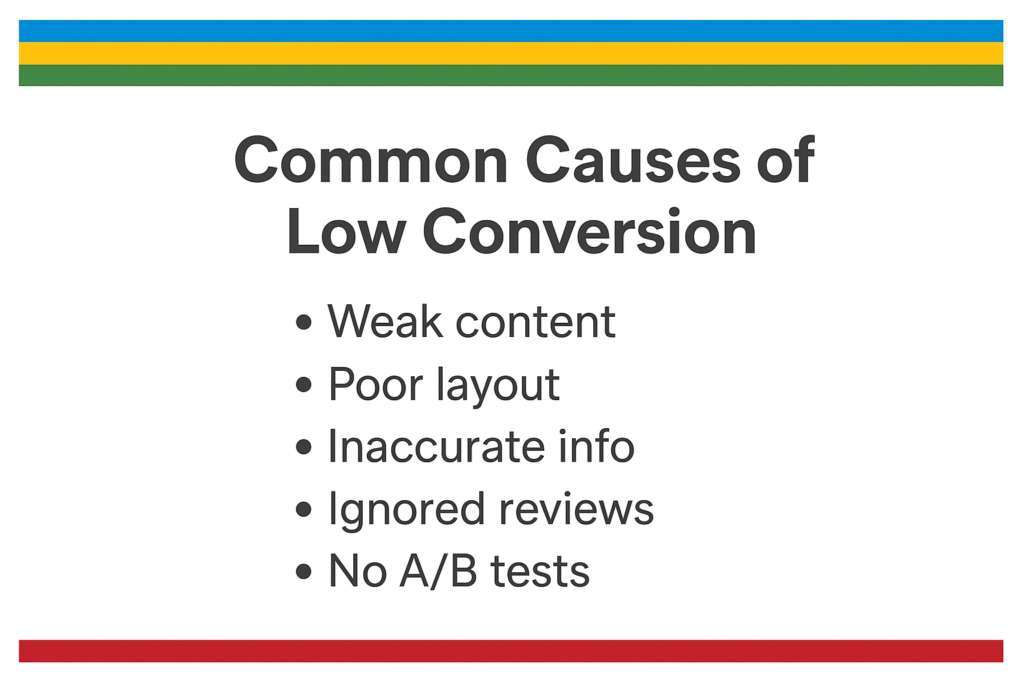
- Poor Product Content Optimization
- Lack of Product Page Design Optimization
- Inadequate Product Information Management
- Ignoring Customer Feedback and Reviews
- Lack of A/B Testing
What is Conversion Rate?
Before diving into the pool of mistakes that could be found on your site, let’s unpack what conversion rate truly means. In eCommerce, it refers to the percentage of visitors who perform the most desired action of buying a product, subscribing, or filling out a form. For product pages, this definition becomes laser-focused: it measures the percentage of visitors who purchase after viewing a product.
If this percentage dips too low, your product page conversion rate is essentially sending you a flare signal. It means the journey from “Hmm, interesting” to “Add to Cart” is disrupted somewhere. Let’s try to pinpoint where that usually happens.
1. Poor Product Content Optimization
One of the most common culprits behind a low PDP conversion rate is weak or insufficient product content optimization. Product pages that lack clarity, charm, or essential details often chase away buyers. People want to understand what they’re buying, and they want that understanding fast.
Consider a few essentials when practicing strong product content optimization:
- Write crisp, clear descriptions. Highlight benefits, not just features.
- Add high-quality product images. They should cover varied angles, zoomed details, and lifestyle shots.
- Optimize titles using keywords your customers are already searching for.
- Make your tone match your brand, yet keep it readable for hurried shoppers
Well-crafted product content is like that friendly neighborhood salesperson who doesn’t push but persuades. When descriptions shine and images glow, your product page conversion optimization improves and nudges the customer to buy.

2. Lack of Product Page Design Optimization
Even the best product content looks lonely when the design surrounding it feels clumsy. A poorly structured layout can sabotage your eCommerce product page metrics in seconds. Visitors want fluid navigation, straightforward visuals, and a sense of clarity right from the start.
Here’s what good product page design optimization should include:
- Fast loading pages: Sluggish pages scare shoppers away.
- Mobile-friendly layouts: Mobile shoppers now dominate traffic across many industries.
- Prominent, unmistakable CTAs that don’t hide in the shadows.
- Trust signals such as customer reviews, star ratings, badges, and guarantees.
- Clean spacing and clear hierarchy. Your page should feel breathable, not crowded.
Your product page should feel like a smooth path, not a maze. When the design supports the visitor’s journey, your product page conversion rate naturally climbs upward.
3. Inadequate Product Information Management
Inconsistent or outdated product information often damages trust, sometimes instantly. Without proper product information management, your customers may see wrong sizes, outdated details, or mismatched descriptions across channels. These inconsistencies can flatten your PDP conversion rate.
A strong PIM system helps you:
- Centralize product data
- Maintain accuracy.
- Update information seamlessly.
- Ensure consistency across all platforms.
True product page conversion optimization depends heavily on accurate and trustworthy details. If people feel unsure, they won’t buy. It is as simple as that.

4. Ignoring Customer Feedback and Reviews
Customer voices hold extraordinary power. Reviews and feedback reveal tiny cracks inside your product pages that you may not notice. When businesses ignore them, their eCommerce product page metrics suffer quietly.
Make feedback a treasure map:
- Monitor reviews regularly
- Identify repeated concerns.
- Respond to customers politely and promptly.
- Use feedback to enhance descriptions, add FAQs, or upgrade images.
When shoppers see that you listen, trust is built, and trust fuels conversions.
5. Lack of A/B Testing
A/B testing is the researcher for eCommerce. It helps you compare two page variations and discover which one wins the conversion battle. Without it, your product page conversion optimization is based on assumptions rather than data.
Test elements such as:
- Hero images
- Descriptions
- CTA wording
- Button placement
- Page layout
A/B testing turns uncertainty into clarity. And in eCommerce, clarity is currency.

FAQs
1. Why does my product page conversion rate drop suddenly?
It often dips due to design changes, slow-loading pages, missing information, or technical issues that disrupt the buyer journey.
2. How do I improve my PDP conversion rate quickly?
Start by fixing content gaps, updating images, improving mobile responsiveness, and tightening your CTAs.
3. What are essential eCommerce product page metrics to track?
Key metrics include conversion rate, bounce rate, add-to-cart rate, time on page, and CTA click-through rate.
4. Should I perform A/B testing on every product page element?
Not everything needs testing, but major elements like images, titles, and CTA styles benefit the most from A/B tests.
5. How does Product Content Optimization affect conversions?
Clearer descriptions, better visuals, and accurate information boost trust and help visitors make purchasing decisions faster.
Conclusion
Improving your product page conversion rate requires intentional strategy, not guesswork. Avoiding common mistakes like weak product content optimization, poor product page design optimization, inconsistent data management, ignored reviews, and missing A/B tests helps you create a delightful buyer experience. Your product pages are the storefront windows of your digital shop, and when they shine, customers walk in.
A low product page conversion rate is a pattern of correctable missteps. When you refine your product content optimization, smoothen your product page design optimization, harness customer reviews, upgrade data accuracy, and embrace A/B testing, your pages begin converting with far more confidence. And once your product pages feel intuitive, informative, and inspiring, your conversion metrics will start singing victories.
Ready to take your product page conversion optimization to a sharper level?
Merchmetric gives you deep insights, automated optimization tools, and data that transforms your product pages into true conversion engines.
Unlock smarter eCommerce decisions today with Merchmetric.
Suggested Reads
https://www.merchmetric.com/blog/product-title-optimization-vs-image-a-b-testing/ – Product titles vs images — which A/B test wins faster?
https://www.merchmetric.com/blog/top-10-eCommerce-market-intelligence-reports – A compact guide to the strongest eCommerce intelligence reports.
https://www.merchmetric.com/blog/top-6-eCommerce-product-page-metrics/ – simple look at the metrics that matter most for product pages.
https://www.merchmetric.com/blog/the-next-generation-of-PDP-optimization/ – PDP optimization is evolving with new tools and tech.

Kimberly Morrison
Kimberly Morrison has been the Director of Client Relations at VGROW since 2019. She builds strong customer relationships, drives client retention, and oversees team productivity. Kimberly's approach to customer engagement is key to VGROW's aim of streamlining business processes through virtual assistance services.

